|
||||||||
|
||||||||
|
ST usually begins spontaneously, although sometimes it is preceded by injury or trauma to the neck. The severity and the frequency of spasms may vary amongst sufferers, but these generally progress over time. The disease is unlikely to go away on its own, especially if present for more than five years. Activity, stress and anxiety may aggravate the spasms, whereas relaxation partially relieves symptoms (sleep usually provides total relief). Spasmodic movements may be partially relieved by gentle touch to specific parts of the face, such as a finger placed on the chin. These maneuvers are called "gestes antagonistiques". ST can lead to uneven shoulders, enlarged muscles, arthritis in the neck and headaches. There is no effect upon cognition, strength, sensation or other nerve function. However, this disorder can become physically, emotionally and socially debilitating. Diagnosis
of primary ST is based on clinical findings, or information from the
effected individual. There are no specific tests to confirm the diagnosis.
However, various investigations may be used to exclude other causes
of abnormal position. |
||||||||
|
|
||||||||

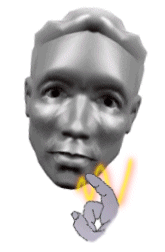 Spasmodic Torticollis (ST),
also known as Cervical Dystonia, is characterized by involuntary movements
of the head as a result of muscle spasms in the neck and shoulders.
These spasms can cause the head to turn, jerk or pull to one side (rotational),
towards the shoulder (laterocollis), forward (anterocollis) or backward
(retrocollis). The movements can be sustained, (tonic) or intermittent
and jerky (clonic) or a combination. Spasmodic Torticollis can also
cause pain in the neck or shoulders.
Spasmodic Torticollis (ST),
also known as Cervical Dystonia, is characterized by involuntary movements
of the head as a result of muscle spasms in the neck and shoulders.
These spasms can cause the head to turn, jerk or pull to one side (rotational),
towards the shoulder (laterocollis), forward (anterocollis) or backward
(retrocollis). The movements can be sustained, (tonic) or intermittent
and jerky (clonic) or a combination. Spasmodic Torticollis can also
cause pain in the neck or shoulders.