How to cite this
e-document

Felix Paul Greve FPG Frederick
Philip Grove
A Biographical Sketch

When
Frederick Philip Grove came to Manitoba in September
1912, he claimed to be of Anglo-Swedish descent
and nearly forty years old. He was actually born
in 1879 in Radomno, West Prussia, which became
not a
"Russian-German", but a Polish- German
border town after 1918, and since 1945, a town
squarely within Poland's
borders.
Raised
in Hamburg, Greve graduated from the famous Gymnasium
Johanneum in 1898. He then studied classical
philology and archaeology in Bonn and Munich where
he seems to have worked with A. Furtwängler
on a monumental collection of Greek vases. His
1901 Munich police registration boldly states "Privatgelehrter",
a lofty status for a barely twenty-three-year-old
without a university degree.
Greve
soon
frequented Karl Wolfskehl in whose hospitable
Schwabing salon he met a group of artists and writers
surrounding Stefan George, the leading German poet
of his time. His poetry collection Wanderungen and
the lyrical Rococo play Helena
und Damon were
published privately during this time, and he started
translating for several renowned publishers.
In September 1902, he briefly shared an address
with Thomas Mann at the Pension Gisela, and it
is reported that he danced with the unconventional
Franziska von Reventlow.
In
Berlin, Greve became involved with Else Endell who
was the wife of his friend, the Jugendstil architect
August Endell. All three set out for Palermo in late
January 1903, Endell was left behind in Naples.
Greve was arrested in May 1903 for defrauding his
Anglo-German friend Herman Kilian for the enormous
sum of 10,000 Mark, and he
served a prison term in Bonn until June 1904. Upon his
release, he visited André Gide
in Paris, whose Immoraliste he had begun to
translate during his confinement. The "the
Greves" then lived in
Wollerau, Switzerland, and Paris-Plage, France,
from where they paid several visits to H. G. Wells
across the Channel. In early 1906 they returned to
Berlin.
After
some three years, the now highly prolific
translator abruptly left for America in late July
1909, crossing the Atlantic from Liverpool to Montreal
in second class on the White Star Liner Megantic,
just as described in the opening pages of Grove's
1927 book A
Search for America [without mentioning the
ship's name -- his passage was not discovered
until October 1998, more than seventy years later,
and fifty year's after FPG's death). Apart from
being heavily in debt, he had just double-sold
his translation of Swift's Prose
Works, and rather than risking another prison-term,
he disappeared by staging his
suicide. Anton Kippenberg, in a masterly reply
to the alleged widow's accusations that his Insel
Publishing Company had overworked, underpaid
and unfairly criticized Greve, is reluctant to
believe in his demise, but offers her
financial support despite Greve's sizeable debts.
Else
joined her husband in Pittsburgh a year later,
where, in September 1910, she was arrested for cross-dressing
and smoking in public. Within a year of their reunion,
Greve abandoned her on a small farm near Sparta, Kentucky,
in 1911, and made his way towards Canada, via the vast
Bonanza Farm identified in 1996 as the Amenia & Sharon
Land Company near Fargo, N.D. For her part, Else started
posing in Cincinnati, Philadelphia and New York where
she married Baron Leo von Freytag-Loringhoven.
Under this name, she later became well-known in New York
Dada circles which included artists like Man Ray and
Marcel Duchamp. Note that both Else and FPG became guilty
of bigamy when they respectively remarried,
one in New
York in November 1913,
the other in Swift Current, Canada, in August 1914.
After
a decade of teaching in remote districts of
rural Manitoba, Grove started to emerge as a Canadian
writer from
Rapid City in 1922. Often ignored, his first publication
had been the Nietzschean essay "Rousseau als
Erzieher" in the German-Canadian newspaper Der
Nordwesten in November & December of 1914.
It is not unlike Greve's rambling essays. Grove's
first two books were nature studies inspired by
weekly thirty-mile drives from Gladstone to his
wife's school near Waldersee and Amaranth, Manitoba.
Flaubert's symbolic realism, which Greve had embraced
while translating his avowed model in 1904/5, is
in full evidence here. Grove's first novel Settlers
of the Marsh (1925) has a hidden autobiographical
component: it deals with the year he spent farming
with Else near Sparta, Kentucky, the setting being
transformed into rural Manitoba pioneer country.
His
first autobiographical novel A Search for America
appeared in 1927[ e-Ed. 2000], and covered the
three "lost" years between Greve's 1909
passage and Grove's arrival in Manitoba. The Kentucky
year is spared out, the time-frame is distorted
by twenty years, and he appropriates former friend
Kilian's entire family background is as his own.
In the ca. 1925 typescript Jane Atkinson, Grove
makes veiled references to Karl Wolfskehl, and
quotes himself from his 1905 novel about Else's
life, Fanny Essler. Further novels also
are covertly autobiographical, with Fruits of
the Earth and Master of the Mill, for
instance, drawing on the Chaffee family's history
and enterprises of the vast Bonanza Farm operation
in North Dakota.
Grove
began taking extra-mural studies at the University
of Manitoba in 1915, and he obtained his B.A.
in French and German in 1922. In 1914, he had
married his fellow teacher Catherine Wiens, and
the couple had a daughter in 1915. Phyllis
May Grove died in Minnedosa during an appendicitis
operation shortly before her twelfth birthday
in 1927, and the Groves left Manitoba to settle
in Ontario in 1929. Their son Leonard was born
in Ottawa in 1930, while Grove was briefly involved
with Graphic Publishers who had published his Search
for America
in 1927.
Despite
the economically depressed conditions and increasing
ill health, Grove continued to write and publish
from his Simcoe estate, which he acquired in
1931, until his death on August 19, 1948. His
true identity was not discovered until 1971 by
D. O. Spettigue, whose papers documenting FPG's
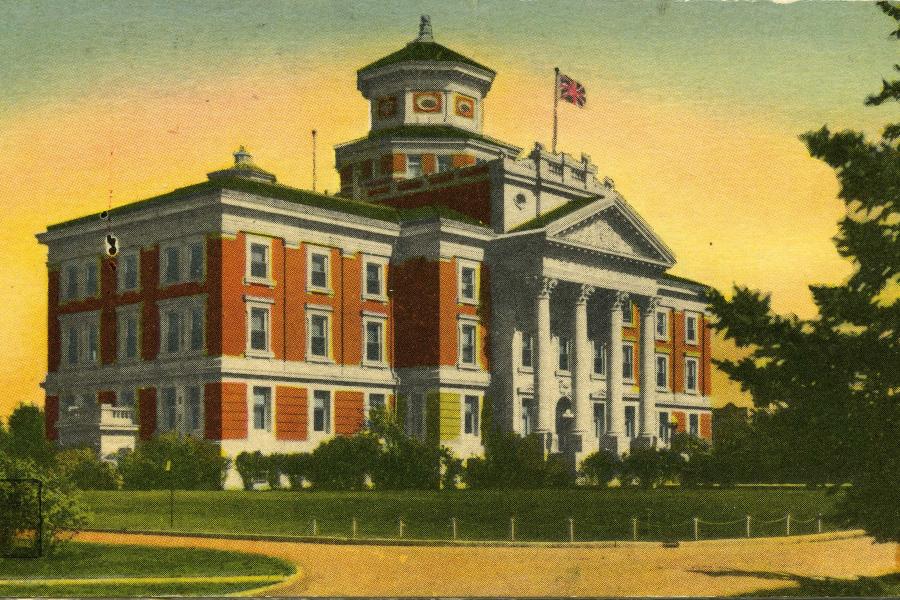
upbringing were deposited in the University of
Manitoba Archives in 1986, and whose seminal
book was made public in 1973.
The
highlight of Grove's career as a Canadian author
had been a highly successful, coast-to-coast lecture
tour organized be the Canadian Club in 1928 & 1929.
He had high hopes of securing a diplomatic position
in Ottawa, but nothing ever materialized. Despite
constant bitter complaints, Grove was highly regarded:
among many further honours he received were the
Lorne Pierce Medal in 1934, the election as a Fellow
of the Royal Society of Canada in 1941, two Honorary
Doctorates from his alma
mater,
the University of Manitoba (D.Litt.) and Mount
Allison University (LLD) in 1946. For his autobiography In
Search of Myself [1946, e-Ed. 2007] he
received the Governor-General's
Award in 1947, for
non-fiction, which is ironic since Grove recanted
many of the quite accurate accounts previously
introduced in 1927, and applied far more "fiction" than "fact" in
using Goethe's openly acknowledged autobiographical
model in Dichtung
und Wahrheit!.
From
1943 until his death, Grove also received monetary
support from the Canadian Authors' Foundation.
In April 1943, he ran -- without success -- for
the Co-Operative Commonwealth Federation in the
Ontario provincial elections.