 |
|

Else & Greve arrested in Pittsburgh
September 17, 1910:
Else von Freytag-Loringhoven & Felix
Paul Greve in the New York Times
(Illustration + Text)
Commentary
prepared by Gaby Divay on occasion
of the Berlin Exhibition
©March 2005
The Canadian author Frederick Philip Grove,
in Manitoba since 1912 and formerly known as Felix Paul Greve, disappeared
in 1909 from Berlin with a faked suicide. As Grove was to describe
in great detail at the very beginning of his first autobiographical
novel A Search for America in 1927, FPG had crossed the
Atlantic in late July as a second class passenger on the White Star
Liner Megantic from Liverpool to Montreal. The boat remained
unnamed, the narrator's age was twenty-four rather than thirty,
and the alleged year was 1892, or twenty years before Greve adopted
his Canadian identity as Grove [Divay, Dec. 1998, publ. 2000].
Eleven months later, in June 1910, Greve's wife Else followed
him to America. It is not clear if Greve had left her in Berlin
as he later left her in Sparta, Kentucky. In an enigmatic letter
to André
Gide in June 1908, he alluded to "a gap" that would soon ensue,
and announced that he was about to be divorced [see Grove, Letters, 1976].
Most likely, he fled hastily and without her knowledge for one
particular compelling reason addressed below. Once settled in
New York, he reconsidered and asked her to join him. However,
Else may well have been privy to his plans to become a rich American "Potato King" from the very beginning. Whatever the case may be,
Else waited some seven or eight weeks before she approached the
director of Insel Publishers, Anton Kippenberg, with an impertinent
note about her husband's disappearance in September 1909. In his
elegant reply, Kippenberg counters one by one her accusations that
he had over-worked, underpaid, and unfairly criticized her husband,
and that he was therefore responsible for Greve's suicide. Kippenberg,
who seems doubtful of Greve's demise, points out that FPG's heavy
debts and "the fact that he has recently offered the same translation
to two publishers at once, and has received payments from both" might
be sufficient reason for seeking voluntary death [Grove, Letters,
1976].
If double-selling his work was perhaps not worth dying for, it
certainly warranted the start of a new life elsewhere. Greve
had already spent a year in prison for defrauding a rich friend
in 1903/4, and he was obviously heading for the penitentiary
again. As a repeat-offender, he would face a far stiffer fraud
sentence than he had six years earlier. In his reply, Kippenberg
goes on to excuse Else's "tone
with the understandable upset you are suffering," and offers
her financial support. An employee, who had come to pick up various
manuscripts, including Dickens David Copperfield, found
the alleged "widow" in gay summer dress and excellent
spirits. The elated mood may well have had its roots in Else's
knowledge THAT & WHERE her husband lived at the time: how
long can one possibly stretch an "understandable" excuse
for reactive, emotional outbursts? Greve had, after all, disappeared
nearly two months earlier!
Else likely took Kippenberg's kind offer to help her, and may
have gone collecting from Greve's other publishers by means
of similar tactics, until she had the necessary funds for her
passage from Rotterdam to New York, and from there to Pittsburgh.
Not long ago, the only known facts were that the scandalous
pair was reunited in Pittsburgh in mid-1910 [Spettigue, 1992],
that they spent roughly one year on a small farm near Sparta,
Kentucky [Divay, 1993], and that Greve left his wife there
for good in late summer of 1911 [FrL's Ab]. He then tramped
along the Ohio down as far as Louisville and went west all
the way to "the Dakotas."
Else modelled at first in nearby Cincinnati, then she made her way
to Philadelphia and New York, where she married Baron Leo, a black
sheep of the illustrious Freytag-Loringhoven family, in November
1913. FPG, now Grove, married his fellow-teacher in Manitoba, Catherine
Wiens, in August 1914. Since Gisi von Freytag-Loringhoven made the
sensational discovery that Greve and Else were united in matrimony
in August 1907, both partners became bigamists in North America.
Else reverted to her maiden-name Ploetz, and although she was thirty-nine
years old in 1913, she declared to be ten years younger to match
the age of the groom. Grove, who was thirty-five in 1914, pretended
to be a forty-year old widower from Moscow, Russia.
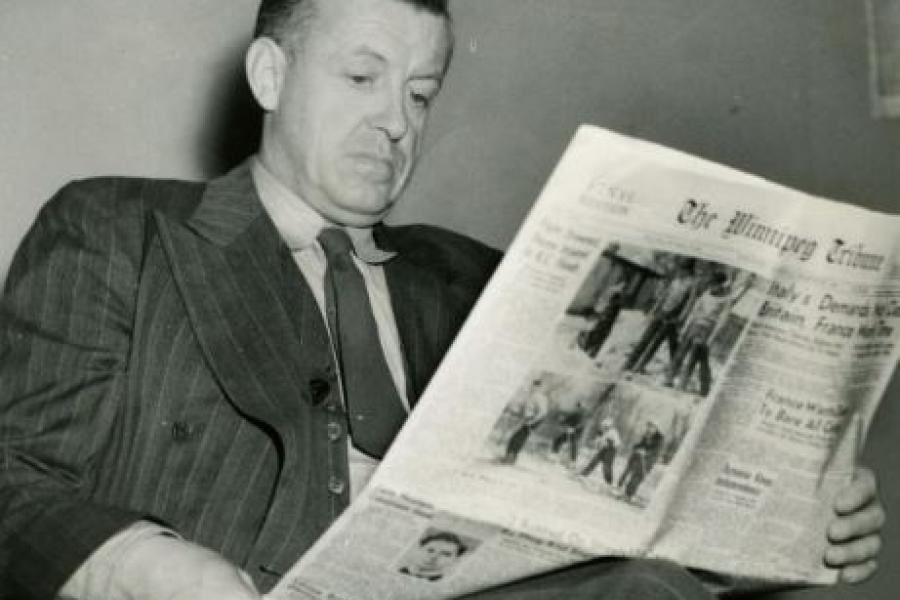
The recent discovery of a note in
the New York Times of September 17, 1910, reveals with the head-line "She Wore Men's Clothes: On Walking Tour
with Husband, Mrs. Greve Explains -- Police Let Couple Go" that
the couple were briefly arrested in Pittsburgh:
"Pittsburg
[sic!], Mrs. Elsie Greve, recently of New York, but
formerly of Berlin, was arrested in crowded Fifth Avenue
this forenoon while walking by the side of her husband,
F. P. Greve of New York, dressed in men's clothes and
puffing a cigarette. Both Mrs. Greve and her husband
were taken, protesting, to the central police station
and locked up as suspicious persons. / Both Greve and
his wife asserted that they were subjects of Germany,
had done no wrong, and intended no wrong. If they were
not released speedily, they would appeal to the German
Ambassador at Washington to-morrow morning, they said.
Whether this threat was considered or not is not known,
but this evening it was announced at Police Headquarters
that Mrs. Greve and her husband had been allowed to
leave the police station and go on their way, and that
Supt. of Police McQuaide issued a letter to the pair
setting forth that Mrs. Greve and her husband were
all right and that the woman was wearing men's clothes
only because she could walk better and keep up with
her husband, who was walking out his vacation." |
Else had declared to immigration officials
in New York on June 29, 1910, that she was on her way to
meet her "brother-in-law T.R. Greve" in Pittsburgh [Spettigue, 1992]. The
reported incident in late September proves that the couple were
still in town some twelve weeks after Else's arrival. When they
finally moved on towards Cincinnati and nearby Sparta, Kentucky,
remains unknown. Like in the newspaper note, Greve was also listed
with his real name "F. P. Greve" as "manager" of an undisclosed
enterprise located at no. 524 on 4th Ave in a 1910 Pittsburgh
directory. As home address, the hilly suburb of Carrick was
mentioned. A few years after this finding, I could also ascertain
what exactly Greve was doing in Pittsburgh at the time, but
that is another story. The brief note about the scandalous
pair in the New York Times fills yet another small hole in
the lofty fabric of FPG's poorly documented three American
years between August 1909 and September 1912.
Dr. Gaby Divay, Archives & Special Collections,
University of Manitoba
Divay, Gaby. "Felix Paul Greve/Frederick Philip
Grove's Passage to America : The Discovery of the Author's Arrival
in North America and Its Implications," New Worlds: Discovering
and Constructing the Unknown: Festschrift for Walter Pache,
München: Verlag E. Vögel, 2000, 111-132.
Divay, Gaby. Introduction to Grove, Frederick Philip. Poems/Gedichte,
Winnipeg: Wolf Verlag, 1993.
Freytag-Loringhoven, Else Baroness von. Autobiography.
ts., 205 p. University of Maryland, College Park ( FrL's Ab).
Freytag-Loringhoven, Gisi Baronin von. Personal communication,
April 2002.
Gisi's discovery is also acknowledged in:
Irene Gammel's comprehensive FrL biography, Baroness Elsa: Gender,
Dada, and Everyday Modernity: a Cultural Biography. Cambridge,
Mass.: M.I.T. Press, 2002.
Grove, Frederick Philip. The Letters of Frederick Philip Grove.
Ed., D. Pacey. Toronto: University of Toronto Press, 1976.
Grove, Frederick Philip. Poems/Gedichte, by F. P. Grove/F.
P. Greve and Fanny Essler. Edited, with an introd. notes and a
concordance, by Gaby Divay. Winnipeg: Wolf Verlag, 1993.
Spettigue, Douglas O. Introduction to Freytag-Loringhoven, Baroness
Elsa, Ottawa: Oberon, 1992.
|
 |
The University of Manitoba
Archives
Winnipeg, MB, Canada R3T 2N2, 1-204-474-6483
Questions or Comments? e-mail Gaby
Divay
©2006/7 UMArchives & Special Collections |
|
 |
|
|