With the acquisition of Frederick Philip Grove's
manuscripts in the early 1960s, the University of Manitoba
Archives established the foundations
of its literary collections. A
very prolific author after 1922 and up to his death in Simcoe, Ontario in
1948, Grove came to Manitoba in December, 1912,
and taught for many years in isolated rural areas in the German-speaking
south and in the Riding Mountain region.
He earned an extra-mural B.A. in 1922, and received an Honourary
Doctorate in the early forties, when he also became a Fellow
of the Royal Society of Canada. Some of Grove's
works are represented on the curricula of Canadian High Schools
and Universities, but interest in him became truly international
only in the 1970s with the revelation of Grove's true identity,
and again in the mid-1980s with Else von Freytag-Loringhoven's
autobiography in which Greve looms large, and which confirms
that he moved to North America rather than perishing in Germany
in 1909.
Professor Spettigue discovered in 1971
that Grove had been a minor literary figure and extremely prolific
translator of mostly European literature before he disappeared
from Germany with
a staged suicide. Many
rare documents concerning Felix Paul Greve's family, schooling,
and literary activities are today available for viewing in
the Spettigue Collection. The Margaret Stobie Collection explored Grove's
early years in Manitoba, and includes interviews with former
students as well as Grove's first publication "Rousseau
als Erzieher" which was serially printed in the German-Canadian
newspaper Der Nordwesten in 1915. The
Gaby Divay Collection contains copies of sources pertaining
to Greve, Grove, and Freytag-Loringhoven, including fourteen
original poems by Greve dating from 1902-1905, the entire correspondence
with his Insel Publishers, many of Freytag-Loringhoven's German
poems addressing Greve and other old acquaintances and pointing
to the couple's farming experience in Sparta, Kentucky, ca.1910-1911.
The remnants of Grove's library were donated by his son, Leonard, in 1992 and contain
many interesting texts formerly translated by Greve as well
as annotations in Greek or Latin reflecting FPG's education
in classical philology and archaeology.
Reflecting the complicated biography
and double-layered careers of FPG in Germany (ca.1900-1909),
the United States (1909-1912), Manitoba (1912-1929), and Simcoe,
Ontario (1931-1948), the Grove Collections cover an unusually
broad range, including Canadian, German, and German-Canadian
literature in all genres, literary translation and reception
history, autobiography, classical philology and archaeology. In addition there are
sources documenting his teaching in rural Manitoba and studying
at the University of Manitoba in the 1910s, German and Canadian
publishing history, Bonanza farming and the grain exchange
in North Dakota and Minnesota, intellectual life in Germany
and Europe around 1900, and contemporary contacts with Thomas
Mann, Stefan George, André Gide, H.G. Wells, and well-known
German scholars, artists and architects.
FPG's companion, Else, (from late 1902
to the late summer or fall of 1912 when Greve left her in Sparta,
Kentucky) became a famous dadaist in New York, Berlin, and
Paris under the name of Baroness von Freytag-Loringhoven in
the 1920s and worked with such noted avant-garde artists as
Marcel Duchamp, Man Ray, Djuna Barnes, Berenice Abbott, and
others. Around 1900 she
was married to the renowned "Jugendstil" architect
August Endell who was a friend of Greve's during his Munich days. She
had had extensive contacts with members of the so-called Stefan
George Circle in the 1890s. This complex adds another important dimension
to FPG Studies--namely, international art history. It is not to be excluded from
the scope of the FPG Research Endowment Fund, though the title
proper does not include it explicitly.
NAME:
The name of this fund shall be the FPG
(Frederick Philip Grove/Felix Paul Greve) & (FrL) Else
von
Freytag-Loringhoven Research Endowment Fund.
PURPOSE:
The main purpose of the FPG (Frederick
Philip Grove/Felix Paul Greve) Research Endowment Fund is
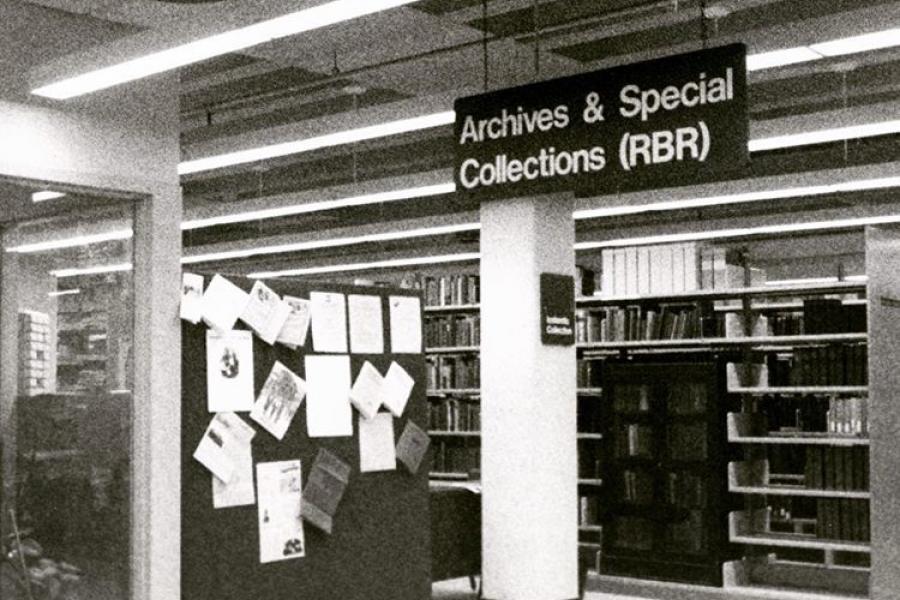
to support, expand, and promote the FPG-related collections
held in the Department of Archives and Special Collections
so that the Department's outstanding resources may become
recognized as the foremost centre in the area of FPG studies
in Canada and
abroad. Such collections
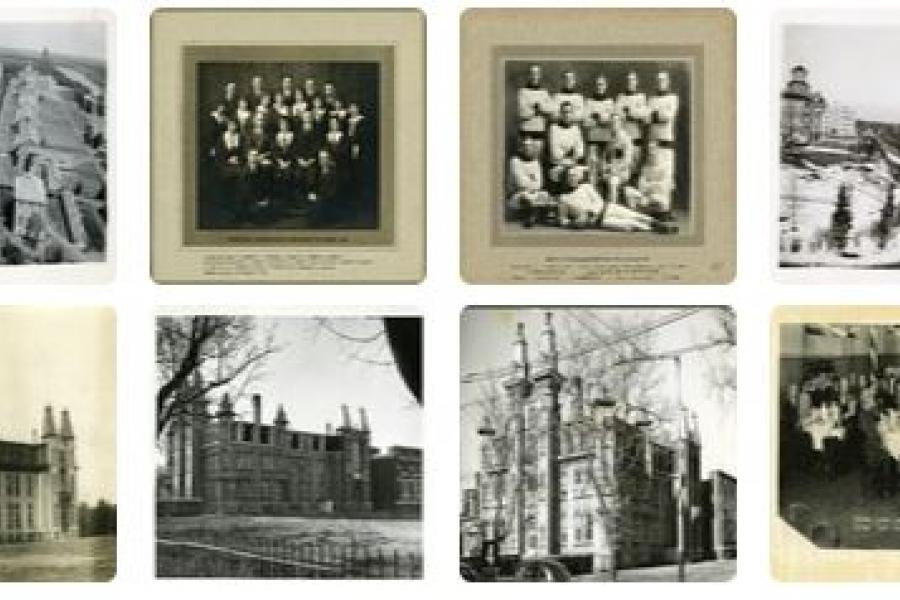
include the central core of F.P. Grove Papers, the F.P. Grove's
Library and Photograph Collections, a good many of Greve's
German translations, and the Baroness von Freytag-Loringhoven
Collection. They are supplemented by the Douglas O. Spettigue, Margaret Stobie,
and Gaby Divay research documents, and a fair number of smaller
collections of theses, microforms, audio and videotapes.
SPECIFIC OBJECTIVES
1.To attract local, national, and international scholars
and researchers by means of descriptive Brochures and enhanced
Finding Aids to be printed or made available on the Internet
and/or in desk-top publishable form.
2.To update these research tools and promotional
items whenever necessary to reflect current knowledge about
FPG and the contents of the FPG collections.
3.To develop an editorial program for FPG's unpublished
writings as well as selected studies or results stemming from
the use of the University of Manitoba's
archival collections or from research elsewhere.
4.To foster and stimulate intellectual exchange of
FPG research through occasional lectures, exhibitions, and
symposia, particularly during anniversary years of significant
FPG life events, or to mark significant research discoveries
of a material or intellectual nature and to record these special
events on video and/or audiotapes.
5.To acquire and make accessible library materials
related to all aspects relevant to FPG's lives and works and
the FPG Collections, including Freytag-Loringhoven's life and
works. Acquisitions may
include primary and secondary documents, manuscripts, theses,
monographs, local history books, research papers, journals,
pamphlets, reprints, off prints, photographs, etc. These
materials shall bear a bookmark with the wording "Provided
by the FPG (Frederick Philip Grove/Felix Paul Greve) Research
Endowment Fund, (year)." An
identical note shall also be added to each cataloguing record.
6.Should the Fund prosper in the future with substantial
donations from others, funding may be available to provide
travel support to worthy scholars who require access to the
Collections. However,
the objectives outlined above are to take priority over this
option. |