



















One of the most complete narrative accounts of Hebrew descent and marriage occurs in Genesis in the details of the lives of the patriarchs: Abraham, Isaac, and Jacob. The details of these well know stories provide both an illustration of some basic principles of the ancient Hebrew social order as well as an indication of several contradictory moral trends that became encapulated in the Old Testament's mythological structure.

As told in the Old Testament, the history of the Hebrews begins with Terah of the Chaldean city of Ur (in Mesopotamia) and his three sons Haran, Nahor, and Abraham. Haran has a son, Lot, by an unspecified wife. Nahor married Milkah, who is noted as Haran's daughter. Whether the Haran mentioned here is Nahor's brother is unclear, since Nahor's father-in-law is identified as the father of Milkah and Iscah, but not of Lot. Abraham is married to Sarah. No mention is given of Sarah's parantage, but later in different Genesis passages, Abraham tells both Pharoh and King Abimalech that Sarah is his sister to avoid hostility from these two rulers, who show a sexual interest in her. When Abimalech confronts him with his deception, Abraham answers that Sarah is his wife but also his half sister by Terah's second marriage.
The three brothers experiencd divergent fates. Haran dies; Abraham migrates to Canaan, taking Haran's son, Lot, with him; Nahor remains in Mesopotamia, giving birth to one son, Bethuel, who fathers Laban and Rebekah.
In Canaan, God promises Abraham that he will become the father of a great nation, but Abraham and Sarah fail to have children. Sarah gives her husband her Egyptian handmaid, Hagar, who bears a son, Ishmael. Sarah finally gives birth to Isaac. Although Ishmael is his eldest son, Abraham designates Isaac as his heir and successor. Isaac's descendents continue in the line of Hebrew descent and Ishmael's form a separate and distinct people, the Ishmaelites.
In the meantime, Lot has separated from Abraham and gone to Sodom. After Sodom is destroyed and Lot's wife dies, he goes into the hills with his two daughters, who trick him into sleeping with them. Each daughter gives birth to a son, who become the ancestors of the Moabites and the Ammonites.
Isaac grows to manhood and when he is ready to marry, Abraham and Sarah make contact with their kinspeople in Mesopotamia to avoid a marriage with the local Canaanites. Isaac is quickly linked up with Rebekah, his patrilateral parallel cousin. Isaac and Rebekah have twin son's, Esau, the eldest by a few minutes, and Jacob. Esau trades his birthright to Jacob for food. He later marries two local Canaanite women, who displease his parents, but eventually regains favor by marrying his parallel cousin, Ishmael's daughter. Isaac dies, but just before his death is deceived by Rebekah and Isaac and gives his blessing and patrimony to Isaac rather than to his oldest son. Fearing Esau's wrath, Jacob flees to his mother's brother's (Laban's) house in Mesopotamia. There he contracts with Laban to work for seven years as bride service for his cousin Rachel. After the term of service, Laban insists that Jacob marry Leah, his oldest daughter, and Jacob has to serve another seven years to eventually earn Rachel's hand.
Jacob returns to Canaan and is reconciled with Esau. Esau becomes the ancestor of a separate people the Edomites. Jacob becomes the progenitor of the Hebrew people through twelve sons born from Leah, Rachel, and their two handmaids. Each son becomes the ancestor of a tribe of Israel, who bear their names.
Although there are varying interpretations and arguements concerning the historical truth of this biblical account, an anthropologist must begin any analysis by assuming that the Genesis stories are myths rather than literal truths. They are the product of oral traditions, in which details have become lost and modified because of inadvertant omissions and deliberate distortions and fabrications. However, independant of historial accuracy, they reveal a great deal about the social life, values, and customs of the ancient Hebrews, especially when they are compared to the myths and customs of other cultural traditions and evaluated in terms of ethnological generalizations.
One obvious interpretation of myths is that they constitute a "charter" for the socio-political structure from which they originate (a position forwarded by Malinowski). As such they proclaim, validate, and insure the continuity of the groups, relations hips, and values that constitute the prevaling social order. Major parts of the Old Testament clearly serve this function and the whole work can be intrepreted a constitution and a set of statutes for the ancient Hebrew kingdoms, sanctioned by divine aut hority. Mythological components, the story elements, serve merely to give exemplification and further authority to the more literal legal proclamations.
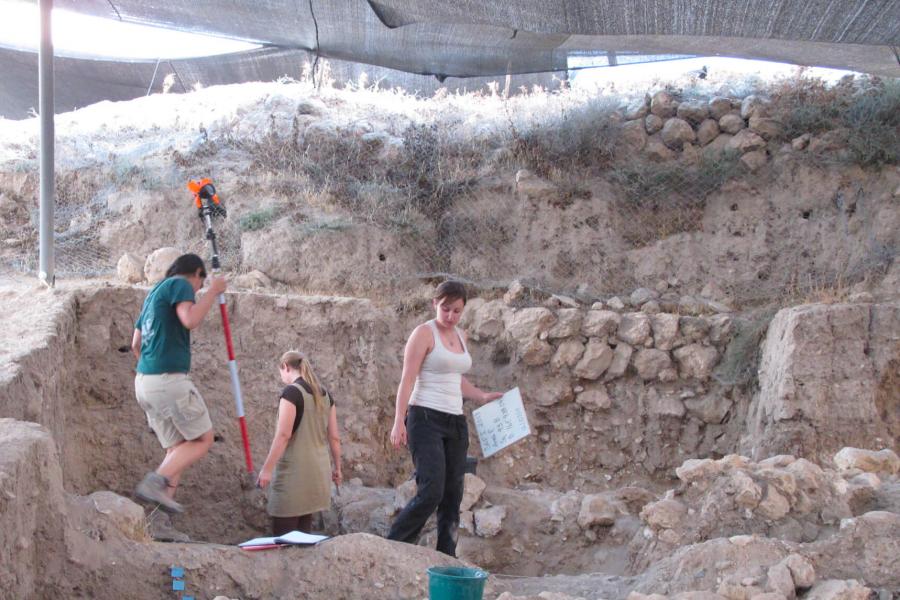
To interpret the biblical myths as constituting a social charter, we must first realize that they functioned in the context of the society in which they were given a coherent consolidated form, the First Kingdoms of Judah and Isreal in the fifth century B .C., rather than that of the time they were considered to have happened hundreds of years earlier. At the time the recording of the Old Testament began, the Hebrews were organized into two culturally related states linked into a series of shifting allian ces and hostilities with their neighbours. The states were subdivided into territorial units, the twelve tribes of Israel. They were organized into settled agricultural villages intregrated into urban based regional religious, political, and economic networks. (Cf: View of the walled city of Hazor established during the reign of Solomon). Special statuses were assigned to reigning royal houses and a hereditary lineage of priests and temple attendants, the Levites. Hebrew groups also remembered a previous social order with a greater degree of decentralization and egalitarianism, based on nomadic pastorialism.
The story of the patriarchs acts to explain and support a number of
fundmental institutions including the integration of peoples of diverse
interests and orgins into a unitary heirarchical state and the construction
of relationships with neighbouring groups.
(Cf: Alternative viewpoints on international relations:
Up to the generation of Jacob's progeny, the biblical genealogy posits an oppostion between a central line of acceptable endogamous origins to establish the purity of Hebrew ancestry and divergent branches marked by incest, slave parentage, and exogamy to denigrate neighboring peoples.
Hebrew customary regulation of marriage and sexual activities are detailed in Leviticus as part of an extensive body of general law and custom. Marriage restrictions (rules of exogamy) are subsumed under incest taboos which apply to sexual relations in general. These restrictions were quite extensive, and infringements could involve severe penalties, including capital punishment. They included bans on homosexual relations and adultery, as well as prohibitions on sex during menstration.
The Hebrew incest taboo pattern shows some interesting differences from current Western prohibitions.
The affinal asymetry can be easily explained as a consequence of the agnatic emphasis in the society. Closely related men within the same patrilineage can more easily maintain cooperative relationships if their wives are placed out-of bounds. The generational asymetry is more puzzling but might be a reflection of a preference for men to marry younger women within a patrilineage, as suggested in the Hebrew origin myth discussed above.
While marriage prohibitions are nicely laid out in a single chapter, the Bible is more cryptic about marriage preference patterns. However there are two clear patterns identified: levirate marriage and lineage endogamy through parallel cousin marriage. Both practice can be understood as emphasizing patrilineal solidarity and continuity. The leverate marriage rule required a man to marry the wife of his deceased brother. (This was not a violation of the incest taboo, which applied only while both brothers were alive.) This practice is found in many cultures and is usually explained from the perspective of alliance theory, which stresses the importance and continuity of close cooperation between lineages interlinked through marital ties. If a link is broken because of a death it must be re-established through the remarriage of the surviving spouse to another lineage member. This explaination does not seem to fit the Hebrew example, where there is little emphasis on inter-lineage marriage alliance. The biblical texts are more concerned with the production of male children who will continue the dead man's patrilineal legacy. In the first account of leverate marriage, Judah's first son, Er, dies and his father tries to marry Er's wife, Tamara, to Ona n, a younger brother. However, Onan makes a forceful display of rejecting this arrangement because he does not wish to produce a child that will be identified as his brother's son rather than as his own. This practice is remaniscent of the practice of ghost marriage among the Nuer, where a deceased man is considered to be the father of any children his wife bears after his death.
The practices of lineage endogamy and parallel cousin marriage is clearly apparent in the geneaology of the patriarchs and is later advocated by Moses in his treatment of a problem of female inheritance at the end of the Book of Numbers. At this point he has apportioned the territories that each of the tribes of Isreal is to occupy when they reach Canaan. Two leaders of the tribe of Judah approach him with a problem that will result from an inheritance rule (detailed in Leviticus) that specifies that a woman inherits her father's property if he has no sons. In this event the property will be passed on to the daughter's children and into her husband's lineage. Moses solves the problem by advocating a new regulation: a woman is to marry her father's brother's son (patrilateral parallel cousin marriage) so that her husband and children will belong to the same lineage as her father and the lineage property can remain intact.