
Department of Occupational Therapy
What we offer
Fieldwork education
Overview
Fieldwork courses provide the major “insitu” experiential component of the MOT program. Under the supervision of a registered occupational therapist, fieldwork provides students with an opportunity to:
- build on the knowledge, skills, and attitudes learned in the classroom;
- connect theory to practice, and practice to theory;
- practice and engage in professional reasoning and problem-solving activities in workplace settings;
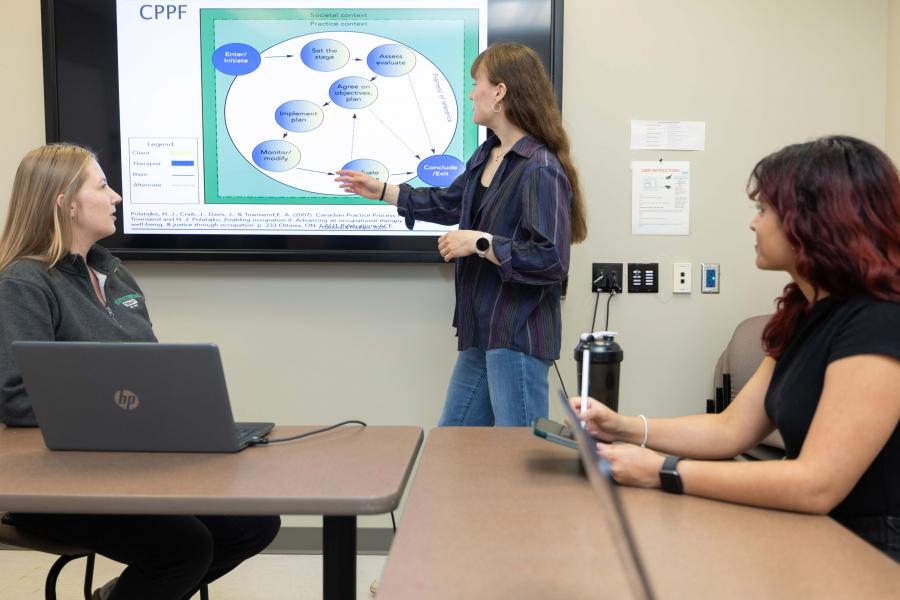
- practice within all stages of an occupational therapy process model in a variety of practice contexts;
- develop interpersonal and communication skills in a variety of practice contexts and with diverse partners (clients, families, groups, communities, team members, etc.);
- engage in interprofessional education opportunities, including a shadowing experience with other disciplines;
- develop an understanding of the importance of, and learn to advocate for, inclusive, collaborative-relationship focused, and equitable practice and gain exposure to the diversity of occupational therapy practice, including clients, ages, health and social conditions, and practice settings;
- engage in professional activities, learn about the realities of professional practice, and begin to develop a professional identity.
The fieldwork curriculum includes four full time “block” fieldwork placements: one 4-week, two 8-week, and one 6-week experience which are named according to experiential levels (Basic Fieldwork, Intermediate Fieldwork 1, Intermediate Fieldwork 2, Advanced Fieldwork) as depicted in the MOT program structure. Fieldwork includes other designated fieldwork hours throughout the program for a minimum of 1000 hours of fieldwork experience.
Over the course of the four fieldwork placements (Basic Fieldwork, Intermediate Fieldwork 1, Intermediate Fieldwork 2, and Advanced Fieldwork) students are supported to develop their professional competence from entry level student to entry level clinician. Please refer to the MOT program guide (pp 29-31) for a description of student professional development throughout the four fieldwork placements. To request a copy of the MOT program guide, please email otfieldwork@umanitoba.ca.
Most fieldwork placements occur in fieldwork sites/programs in Manitoba. Placement opportunities are recruited by the OT department fieldwork team. Students are assigned to sites based on the CAOT accreditation standards and the University of Manitoba Department of Occupational Therapy guidelines for fieldwork placements.
The University of Manitoba fieldwork guidelines state that within the fieldwork components of the MOT program, each of the following is attempted for each student:
- exposure to a variety of OT roles
- experiences in a wide variety of settings, in different areas of practice, with a wide variety of client age groups
- experience with different barriers to occupational participation
- A minimum of one placement:
- with a predominantly psychosocial focus
- in a hospital setting
- in a non-hospital setting
- outside of Winnipeg
If you have questions about fieldwork within the MOT program, or would like to set up a meeting, please contact Teresa Allison, academic fieldwork coordinator, teresa.allison@umanitoba.ca.
Canadian Guidelines for Fieldwork Education in Occupational Therapy (CGFEOT v 2024)
The Canadian Guidelines for Fieldwork Education in Occupational Therapy serve as a guiding resource for the delivery of fieldwork education within the Master of Occupational Therapy program. The CGFEOT v2024 outlines guiding principles; responsibilities of fieldwork education partners (students, university fieldwork coordinator/faculty); and suggested tools and processes to support quality fieldwork education.
2026-2027 placement dates
Basic Fieldwork (4 weeks)
Dates: November 23 – December 18, 2026
Description: First year students who have completed their first term of academics as well as a previous undergraduate degree including prerequisite courses. Evaluated at a Basic level (Level 1).
Intermediate Fieldwork 2 (8 weeks)
Dates: January 4 – February 26, 2027 OR January 11 – March 5, 2027
Description: Second-year students who have completed one and a half years of academic studies, one 4 week and one 8 week fieldwork placement. Evaluated at an Intermediate 2 level (Level 2B).
Intermediate Fieldwork 1 (8 weeks)
Dates: May 3 – June 25, 2027
Description: First year students who have completed one year of academic studies and one 4 week fieldwork placement. Evaluated at an Intermediate 1 level (Level 2A).
Advanced Fieldwork (6 weeks)
Dates: June 28 – September 17, 2027
*Flexible start date; placement must end by September 17, 2027*
Description: Second-year students who have completed all academic acquirements, one 4 week and two 8 week fieldwork placements. Transitioning to practice after this placement.
Becoming a fieldwork educator
Fieldwork educators must be registered occupational therapists with a minimum of one year of practice experience. They are responsible for instruction, supervision and evaluation of an occupational therapy student(s) for an assigned fieldwork placement. Completion of a fieldwork educator Introductory workshop is strongly preferred but not required.
For more information please contact Teresa Allison at teresa.allison@umanitoba.ca.
Fieldwork evaluations
Competency Based Fieldwork Evaluation (CBFE) educator version
Learner performance in fieldwork courses is evaluated at mid-term and final by the fieldwork educator(s) using the Competency-Based Fieldwork Evaluation (CBFE). Due to copyright, we are unable to post the CBFE; however, an electronic version is emailed to fieldwork educators prior to the start of each placement.
Competency Based Fieldwork Evaluation (CBFE) student version and learning log
At mid-term and final, learners are expected to self-evaluate their performance using the CBFE Student Version and Learning Log. The CBFE Student Version is the same as the CBFE Educator version except for the additional of the Student Learning Log at the end which enables learners to keep track of and reflect upon their fieldwork experiences throughout the program.
Student fieldwork experience evaluation form
The student fieldwork experience evaluation form is intended to facilitate a conversation between the learner and fieldwork educator(s) related to the placement orientation, communication/feedback, and supervision. Learners are expected to complete this form at midterm and final and share with their educator(s).
Fieldwork educator training resources
Introductory fieldwork educator workshops
Every fall and spring we host an introductory workshop tailored to new fieldwork educators or educators who are looking for a refresher. For more information, please contact otfieldwork@umanitoba.ca.
Competency Based Fieldwork Evaluation (CBFE) orientation sessions
For fieldwork educators who are new to the CBFE or would like a refresher, we have one hour recorded sessions available for each fieldwork level. For more information, please contact otfieldwork@umanitoba.ca.
Our fieldwork educators tips blog is a place where we post quick and easy tips based on common questions/advice from fieldwork educators, including topics related to feedback, clinical reasoning and facilitating safe learning environments.
The preceptor education program
The preceptor education program is an online interprofessional program designed to prepare and support students and fieldwork educators for fieldwork placements. There are eight interactive modules which take about 30-45 minutes each to complete. A certificate of completion can be generated for each module. As part of fieldwork preparation, students are required to complete all eight modules.
E-Tips for Practice Education is a series of eight short ( approx 10-20 minutes each on line modules offered thorough University of British Columbia.
Book a site visit with the academic fieldwork coordinator
If you have questions about fieldwork education and would like to arrange a meeting (in-person or virtual) please contact teresa.allison@umanitoba.ca.
Other workshops available on request
If you are interested in customized workshop topics for your practice setting, such as feedback/evaluation or different models of offering fieldwork, please contact teresa.allison@umanitoba.ca.
Department of Occupational Therapy fieldwork policies
The Department of Occupational Therapy Fieldwork Policies serve as a guide for students, faculty, fieldwork educators, and fieldwork site contacts about fieldwork placements. Information related to contact with fieldwork sites, liability and insurance coverage, fieldwork requirements, fieldwork hours, evaluation/grading in fieldwork, professional behaviours and more.
Rady Faculty of Health Sciences policies
When students enter fieldwork, we view each fieldwork site as an extension of our university learning environment, in which the following policies apply related to creating culturally safer and inclusive learning environments:
Fieldwork education team contacts
Teresa Allison
Academic fieldwork coordinator
Department of Occupational Therapy
teresa.allison@umanitoba.ca
Nicole Chan
Administrative coordinator fieldwork placements
otfieldwork@umanitoba.ca
Julie Braga
Fieldwork outreach developer
julie.braga@umanitoba.ca
Daniel Doerksen
Fieldwork outreach developer
danieljacob.doerksen@umanitoba.ca
Jodene Neufeld
Fieldwork outreach developer
jodene.neufeld@umanitoba.ca
Supports for student success


Internationally educated health professionals
Community and partners
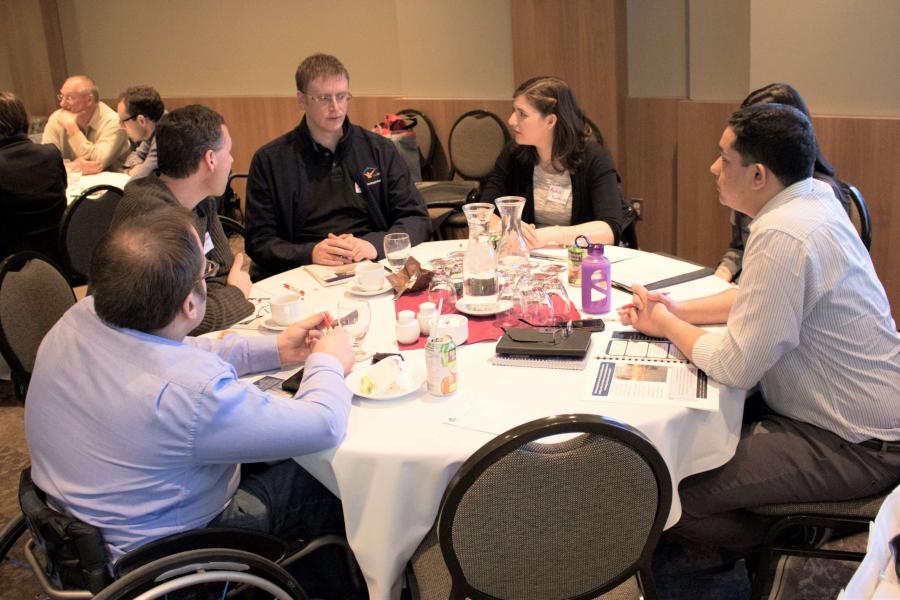
Opportunities for collaboration
Strong links with the community are critical in providing a quality educational program. There are many opportunities for occupational therapists to collaborate with the Department of Occupational Therapy - examples are listed below.
Fieldwork education
We are always looking to expand our network of fieldwork placement opportunities across a variety of practice areas to support the education and development of our students. If you are interested in contributing to their learning journey by offering a placement, please contact Teresa Allison at teresa.allison@umanitoba.ca.
Other teaching opportunities
Case study development
How you can help: Write a case study or contribute ideas for case studies to help students learn about the complexities of practice based on real-life situations.
Contact: cara.brown@umanitoba.ca
Critical Inquiry projects
How you can help: Collaborate on a critical inquiry student project.
Contact: Lisa.Engel@umanitoba.ca
Marking
How you can help: Assist with marking student assignments throughout the academic year.
Contact: cara.brown@umanitoba.ca
Teaching
How you can help: Contribute to the education of our students as a guest lecturer, lab demonstrator, seminar leader, or problem-based learning tutorial leader.
Contact: cara.brown@umanitoba.ca
Research collaborations
Are you interested in advancing occupational therapy research? Collaborate with our faculty members on meaningful research projects that impact the profession. Upcoming opportunities will be posted on our website and promoted in the Manitoba Society of Occupational Therapists newsletter.
To get involved or learn more, contact Leanne Leclair at leanne.leclair@umanitoba.ca.
You may also be looking for
Contact us
Dean's office
College of Rehabilitation Sciences
P304 - 770 Bannatyne Avenue
University of Manitoba
Winnipeg, MB R3E 0W2 Canada
204-789-3897
204-789-3927