Showcase your expertise and passion for research
Thursday, October 22, 2026
Join us for the Undergraduate Research Showcase — your chance to share your passion for research, connect with fellow innovators, and potentially win one of the cash prizes.
Undergraduate Research Showcase
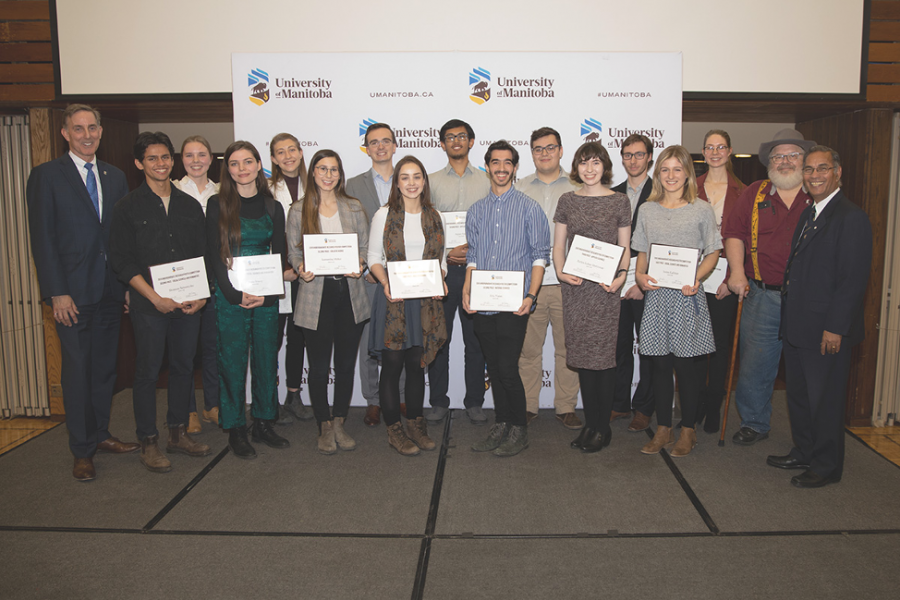
Click here to read about the winners of the 2025 Undergraduate Research Showcase.
About the competition
We want to know what you did this summer ! Come join The Undergraduate Research Showcase and share your research with the UM community !
What is the Undergraduate Research Showcase ?
The Undergraduate Research Showcase (formerly the Undergraduate Research Poster Competition) is a one day-event where undergraduate students can showcase the exciting and innovative research they’ve done over the past year and be eligible to win cash prizes.
There is a total of $7,500 in cash prizes up for grabs, split across five categories:
Applied Sciences
Creative Works
Health Sciences
Natural Sciences
Social Sciences and Humanities
Competition Format
This year, the Undergraduate Research Showcase will have three separate competition streams: the Oral Presentation Stream, Poster Presentation Stream, and the Innovation Stream. Click the icons to learn more about each competition stream !

Dates and Deadlines
Upcoming Important Dates
-
Application period opens
-
Registration window closes
-
Judge info session (via Zoom by invite only) 12:00 PM - 1:00 PM
-
Undergraduate Research Showcase
Eligibility
The Undergraduate Research Showcase is open to all UM undergraduate students who:
Are enrolled at UM as an undergraduate student
Are on track to obtain a UM undergraduate degree
Have a UM-affiliated research supervisor (i.e., through the URA, NSERC USRA, similar undergraduate research placements, etc.)
Have a UM supervisor (excluding co-ops that don't have adjunct/UM affiliation)
Students who have a supervisor through the Honours thesis program, Honours program special course, or similar stream, are also allowed to apply.
Note: Students who graduated in Spring 2026 are eligible to participate, as long as the research being showcased was completed while they were an undergraduate student.
Format and Specifications
New this year: Innovation Stream!
Stream 1: Oral Presentation
Students will have a maximum of 3 minutes to explain/describe their research project in any means/media format of their choosing. Examples may include: Oral presentations, PowerPoint presentations, 3-D Demonstrations, Videos, etc.
Frequently Asked Questions:
What should an oral presentation look like ? Do I need to prepare anything in advance ?
Presentations in the Oral Stream:
- should be approximately 3 minutes long (followed by a 2-minute Q & A period, for a total of 5 minutes max per presenter)
- may include optional visual components that supplement your presentation, such as
- PowerPoint slides
- a pre-recorded video
- a displayable PDF file
- images/renders, 3D models, dioramas, etc. (displayed on screen or brought into the space)
Generally, most Oral Stream participants will prepare PowerPoint slides to supplement their presentation. These slides (and any other form of supplementary content) will be requested by the URS team at some point after the registration period closes.
Please note that for those who decide to bring physical work or material to supplement their Oral Stream presentation (i.e., dioramas, models, etc.), we will have a dedicated section of the space for you to display these outside of your oral presentation slot. Since the Oral Stream presentations will take place on a small platform, you may not be able to display physical works or material during your presentation, due to safety hazards. We are not responsible for any damages incurred. Students interested in bringing physical work/material must contact the URS team in advance.
Will there be anything provided to me to help with my oral presentation ?
All presenters will have access to a microphone and a projector + screen, which will both be located in the Oral Presentation space.
For those who wish to make use of the projector to display any virtual visual components, please be sure to provide us with the necessary files beforehand. There will be a laptop on site from which you can access your files. Please note that we may not be able to accept files that require a unique program/application.
Are there restrictions on what I can bring to/include in my Oral Presentation ?
Yes. Please note that the following are considered restricted and not allowed in the Oral Presentation Stream (although they may, however, be included as a purely virtual visual component, such as a PowerPoint Presentation or pre-recorded video):
- the use of live specimens, samples, or animals
- live experiments performed on-site in or near the Oral Presentation Space
the use of hazardous materials or chemicals
Will presentations in the Oral Stream be judged ?
Yes, all presentations, whether in the Oral Stream or the Poster Stream, will be judged by 3 judges, selected from members of the UM community (faculty members, professors, researchers, etc.).
You can view the judging criterions below.
Will I have the opportunity to talk about my research after my Oral Presentation ?
Yes ! There will be areas spread across the Multi-Purpose Room for Oral Presentation Stream participants to further discuss their research with those in attendance. Please note that this will not count towards judging. These spaces and opportunities are there for:
- students who wish to learn more about the research that their colleagues are doing
- those who want to have collaborative and insightful conversations with UM researchers (both faculty and students) or display concepts covered in their presentation (such as a small visual installations)
- are eager to talk more about their research and research experiences with members of the UM research community.
Stream 2: Poster Presentation
For the Poster Presentation stream, students will be required to set up their posters at an established time. Judging will take place throughout the day, with results being shared after the judging period has concluded. The posters should be comprehensive, engaging, and effective at conveying concepts, ideas, or information.
Posters must fit within the assigned display space. Electronic displays, monitors, television, projectors, and other audiovisual equipment are not permitted unless explicitly approved by the organizing committee in advance as an accessibility accommodation.
Frequently Asked Questions:
What size can my poster be?
You will be assigned a 4'H X 8'W Poster Board on which to display your research, scholarly work or creative activity. Please note that you will need a 4"H X 11"W space in the upper right hand corner for the poster board number identifying your project. Other than that, the space is yours. You are free to use large-scale poster paper or build your poster in whatever way best suits your interests, as long as it stays within the total dimensions shown here.
Include the correct UM logo per the brand guidelines.
What should a Poster Presentation look like ?
Posters in in the Poster Presentation Stream:
- should abide by the applicable space and specifications/dimensions that are listed on this page.
- Can include supplementary components outside of the poster board, such as:
- small dioramas/displays
- scaled models
Please note that the Undergraduate Research Showcase team will not be responsible for the loss or damage of any posters or supplementary components. All supplementary components outside of the poster board must fit within the space space in front of your poster board, and must not obstruct the pathways in the room, nor can they obstruct the poster boards of other participants.
Do I need to be present at my poster for the entire duration of the Undergraduate Research Showcase ?
We encourage students to stay near their posters and share their research with those in attendance, which includes other UM students and members of the UM research community, as judges will be in the hall throughout the day looking at posters. This is meant to be an event that gives students the means to showcase their exciting and innovative research and research experiences, and so we encourage you to take advantage of that and share your work, while also taking the time to check out the work of your fellow UM students !
Can I bring in things other than my poster to showcase my research ?
Students who have registered to participate in the Poster stream but wish to showcase their work through more than just their poster are allowed to bring in additional material(s) to do so. This can include supplementary things like:
- physical/material work such as small dioramas or models related to your research
- flash cards and other forms of interactive devices, that may have been a critical part of your research
Please note that these components, if brought in and used, will not be part of the judging process. In addition, these supplementary materials are expected to remain by your poster at all times. There will be approximately 1.5 ft (18 inches) of clearance in front of your poster.
The URS team is not liable for any damages related to the supplementary material. Students must also remain mindful of the space they occupy, and as such, not all forms of supplementary materials may be accepted due to safety reasons. Those still interested in bringing supplementary materials must contact the URS team in advance.
Stream 3: Innovation Presentation
Have an innovative idea, prototype, design, demonstration, or creative solution to share? The new Innovation Stream provides an opportunity for students to showcase innovative projects and ideas in a more interactive format.
Presentations in this stream will be primarily oral and demonstration-based and may include:
- Oral presentations or pitches
- Demonstrations of prototypes or projects
- 3D models or physical displays
- Innovative designs, concepts, or solutions
- Technology or product demonstrations
- Creative approaches to solving real-world problems
Students are encouraged to think beyond traditional research presentations and show us what they have created, developed, designed, or imagined!
Frequently Asked Questions:
How long is the Innovation Stream presentation?
Each presentation will be 5 minutes long.
Can I use PowerPoint slides?
No. PowerPoint slides and traditional slide-based presentations are not permitted. The Innovation Stream is designed to be primarily oral and demonstration-based.
Where will the Innovation Stream presentations take place?
This stream will be hosted in the new IDEA START Program space in the University Centre, providing an opportunity for students to share their ideas in an environment to encourage innovation, creativity, collaboration, and entrepreneurship. PowerPoint slides and traditional slide-based presentations are not permitted. The Innovation Stream is designed to be primarily oral and demonstration-based.
The Venue:
The Multi-Purpose Room (Rooms 210-224, 2nd Floor, University Centre) will be used for Poster, Oral, and Innovation presentations. It will contain "neighbourhoods" or clusters based on related research topics within each category. There will be some zones reserved for oral presentations, speckled with clusters of poster submissions.
Judging Rubric - Oral Stream
Participants in the Oral Presentation Stream will be evaluated on the following criteria:
| Undergraduate Research Showcase (URS) Rubric - Oral Presentation Stream |
| ||||
Criteria | Score Range | Score | ||||
5 | 4 | 3 | 2 | 1 | ||
Content | All information is highly relevant, clear, and exceptionally easy to understand | Most information is relevant and clear, with only minor issues affecting understanding | Information is somewhat relevant and clear, but has noticeable gaps | The information is partially relevant and clear, with significant gaps cause confusion | Information is mostly irrelevant or unclear, making it difficult to understand the content |
|
Accuracy | No spelling or grammar mistakes | Minor spelling or grammar mistakes | Several notable spelling or grammar mistakes | Significant spelling or grammar mistakes | Excessive spelling or grammar mistakes that hinder comprehension |
|
Structure | Exceptionally well-organized with a logical sequence and well-defined headings | Very well-organized with a mostly logical sequence and clear heading | Reasonably well-organized with some issues in sequence and headings | Partially structured, with noticeable problems in sequence and unclear headings | Disorganized with a confusing sequence and absent headings |
|
Design | Highly visually appealing; colors, fonts, and graphics (e.g., tables, photos, charts) are expertly used | Overall visually appealing; not cluttered; colors, fonts, and graphics are well arranged | Visual appeal is adequate; use of colors, fonts, and graphics is somewhat inconsistent | Limited visual appeal; with some room for improvement in visual integration | Visually unappealing, with notable issues in color, fonts, and layout that detract from the content |
|
Oral Presentation | Presentation was perfectly timed; articulation was distinct, with strong eye contact | Presentation was well-timed; clear articulation and consistent eye contact | Presentation was slightly off-timed; generally clear articulation and good eye contact | Presentation was poorly timed; articulation was inconsistent, with limited eye contact | Presentation was significantly off-timed; articulation was unclear, and eye contact was minimal |
|
Engagement | Narration and/or answering of questions is engaging, thorough, and adds greatly to the presentation | Narration is clear, with effective handling of questions | Narration is generally clear; responses to questions are sufficient | Narration is adequate, with minimal engagement and superficial responses to questions | Narration is unengaging, only short or evasive responses to questions |
|
Impact | Research has a profound and far-reaching impact; offers groundbreaking insights or solutions that significantly advance the field | Research has a significant impact; provides important new insights or solutions that advance the field considerably | Research has a notable impact; offers valuable insights or contributions that are relevant to the field | Research has a moderate impact; provides some useful insights or contributions but with limited significance | Research has minimal impact; offers few new insights or contributions and has limited relevance to the field |
|
Novelty | Highly original; introduces groundbreaking ideas | Very original; offers significant new approaches | Somewhat original; adds new insights but not groundbreaking | Limited originality; mostly reaffirms existing knowledge | Lacks originality; repeats existing knowledge or methods | |
Total Score | 40 | |||||
Judging Rubric - Poster Stream
Participants in the Poster Presentation Stream will be evaluated on the following criteria:
| Undergraduate Research Showcase (URS) Rubric - Poster Presentation Stream |
| ||||
Criteria | Score Range | Score | ||||
5 | 4 | 3 | 2 | 1 | ||
Content | All information is highly relevant, clear, and exceptionally easy to understand | Most information is relevant and clear, with only minor issues affecting understanding | Information is somewhat relevant and clear, but has noticeable gaps | The information is partially relevant and clear, with significant gaps cause confusion | Information is mostly irrelevant or unclear, making it difficult to understand the content |
|
Accuracy | No spelling or grammar mistakes | Minor spelling or grammar mistakes | Several notable spelling or grammar mistakes | Significant spelling or grammar mistakes | Excessive spelling or grammar mistakes that hinder comprehension |
|
Structure | Exceptionally well-organized with a logical sequence and well-defined headings | Very well-organized with a mostly logical sequence and clear heading | Reasonably well-organized with some issues in sequence and headings | Partially structured, with noticeable problems in sequence and unclear headings | Disorganized with a confusing sequence and absent headings |
|
Design | Highly visually appealing; colors, fonts, and graphics (e.g., tables, photos, charts) are expertly used | Overall visually appealing; not cluttered; colors, fonts, and graphics are well arranged | Visual appeal is adequate; use of colors, fonts, and graphics is somewhat inconsistent | Limited visual appeal; with some room for improvement in visual integration | Visually unappealing, with notable issues in color, fonts, and layout that detract from the content |
|
Poster Presentation | Exceptional Confidence: Presenter consistently maintains eye contact; demonstrates thorough understanding of the research; uses lay language effectively | Strong Confidence: Presenter maintains eye contact throughout; demonstrates a solid understanding of the research; uses lay language effectively with minor exceptions | Moderate Confidence: Presenter generally maintains eye contact; shows a good understanding of the research; mostly appropriate use of lay language | Some Confidence: Presenter occasionally maintains eye contact; demonstrates basic understanding of the research; language used is mostly accessible | Lacks Confidence: Presenter does not maintain eye contact; demonstrates little understanding of the research; uses overly complex and difficult to access language. |
|
Engagement | Narration and/or answering of questions is engaging, thorough, and adds greatly to the presentation | Narration is clear, with effective handling of questions | Narration is generally clear; responses to questions are sufficient | Narration is adequate, with minimal engagement and superficial responses to questions | Narration is unengaging, only short or evasive responses to questions |
|
Impact | Research has a profound and far-reaching impact; offers groundbreaking insights or solutions that significantly advance the field | Research has a significant impact; provides important new insights or solutions that advance the field considerably | Research has a notable impact; offers valuable insights or contributions that are relevant to the field | Research has a moderate impact; provides some useful insights or contributions but with limited significance | Research has minimal impact; offers few new insights or contributions and has limited relevance to the field |
|
Novelty | Highly original; introduces groundbreaking ideas | Very original; offers significant new approaches | Somewhat original; adds new insights but not groundbreaking | Limited originality; mostly reaffirms existing knowledge | Lacks originality; repeats existing knowledge or methods | |
Total Score | 40 | |||||
Judging Rubric - Innovation Stream
Participants in the Innovation Presentation Stream will be evaluated on the following criteria:
| Undergraduate Research Showcase (URS) Rubric - Innovation Presentation Stream |
| ||||
Criteria | Score Range | Score | ||||
5 | 4 | 3 | 2 | 1 | ||
Problem Significance | Addresses a highly important and well-defined challenge with broad relevance and clear need | Addresses an important challenge with strong relevance | Addresses a moderately relevant problem | Addresses a problem of limited significance or unclear need | Problem is poorly defined or lacks relevance |
|
Innovation | Demonstrates a truly novel idea, approach, product, or process | Demonstrates strong innovation | Shows some innovative elements but builds largely on existing approaches | Limited innovation; modest modifications to existing work | Little or no evidence of innovation |
|
Research-to-Innovation Translation | Research findings are exceptionally well translated into a tangible innovation, application, or solution | Strong connection between research and innovation outcomes | Research contributes to innovation but connection is only partially developed | Innovation outcome is weakly linked to the research | Little evidence that research generated a meaningful innovation |
|
Potential Impact | Innovation has transformative potential with significant societal, economic, environmental, cultural, or health benefits | Innovation has substantial potential impact | Innovation could provide moderate benefits or improvements | Limited or localized impact | Minimal or unclear potential impact |
|
Feasibility & Implementation | Highly feasible; clear pathway for implementation, adoption, testing, or commercialization | Feasible with only minor barriers to implementation | Moderately feasible but requires further development | Reduced feasibility due to significant barriers | Unclear or unrealistic implementation pathway |
|
Evidence & Validation | Strong evidence and validation support the innovation | Good evidence supports the innovation's value and performance | Some evidence or preliminary validation is provided | Limited evidence supporting the innovation | Little or no validation presented |
|
Communication & Demonstration | Innovation is communicated exceptionally and demonstrated effectively to a broad audience | Innovation is communicated clearly and demonstration is effective | Communication is generally understandable with some gaps | Communication lacks clarity or demonstration is limited | Communication is unclear and the innovation is difficult to understand |
|
Future Potential & Scalability | Clear opportunities for growth, scaling, further development, or broader adoption | Strong future development opportunities identified | Some future applications or development pathways identified | Limited consideration of future potential | No meaningful future opportunities discussed | |
Total Score | 40 | |||||
Resources and Information
The Undergraduate Research Poster Competition is a recognized UM Co-Curricular Record activity and all participants will be recognized.
- 2026 Undergraduate Research Showcase - Student Info Session Material - PDF
- 2026 Undergraduate Research Showcase - Judge Info Session Material - PDF
- 86+ million tips for creating a research poster presentation from Google
- Ten Simple Rules for a Good Poster Presentation - from 2007, but still relevant!
- 8 ways to create a powerful research poster - tips on using white space, colour, organization and fonts.
- Design tips for creating arts and humanities posters – from Mark McDayter’s blog
Frequently Asked Questions
I am now in a Master’s program at UM. Can I submit a poster I completed before I graduated?
Yes, as long as you were a UM undergraduate student and the poster was completed on/before you graduated in Spring 2026.
I am a UM student doing research at another university – am I still eligible to participate in the competition?
Yes, as long as you are registered/enrolled at UM as an undergraduate student.
Could I submit a poster for a project that isn't completed yet?
Yes. We don’t want to discourage you, so if you are comfortable entering the competition with uncompleted work, we will accept the poster.
I did a project this summer with a company where I worked. Could I present the research work I did with them at this competition?
Yes. As long as you are currently enrolled as an undergraduate student and you have a UM advisor, we will accept the poster.
This summer I participated in a project with many people working on it. Should my poster demonstrate the entirety of the project or just my contribution as a research assistant?
Preferably, you should be the first author of the research on the poster. A disclaimer is highly recommended. You need to be able to identify your role in the context of the larger project. Also, you must contact the others involved for their permission should you present the entirety of the project.
How do I know which category my poster will fall under?
You should check with your research advisor.
I have an exam on the day of the event. Do I need to stay for the whole time during the competition?
No. The poster should be self-explanatory and you will not be deducted any points for not being at your poster. You are, however, expected to collect your poster after 4:30pm the day of the event. Please note though that judges and general attendees will be in the room throughout the day, so this may be a great opportunity to gain experience sharing and conveying your research work to an audience !
Am I required to speak briefly about my poster? Should I prepare a speech or will the presentation of the poster be more of a conversation with the judges?
As the Poster Presentation and delivery is a criterion of the evaluation rubric, you are encouraged to talk about your poster and describe your research. The judges may ask you questions in conversation should you be present at the same time as them.
Are students enrolled in an advanced-entry program (e.g., the Doctor of Medicine (MD) Program) eligible to participate in the competition?
Students enrolled in advanced-entry programs are not eligible, as they are not considered undergraduate students.
Are students enrolled in the PharmD program eligible?
PharmD students are eligible, as the PharmD program is classified as a four-year undergraduate doctoral program.