
UM Grow Your Community Fund
The UM Grow Your Community Fund provides one-time seed funding and training to support UM students and grassroots UM student organizations who identify as minoritized, marginalized or as members of under-represented groups in building community on campus through the Community Leadership Development Program.
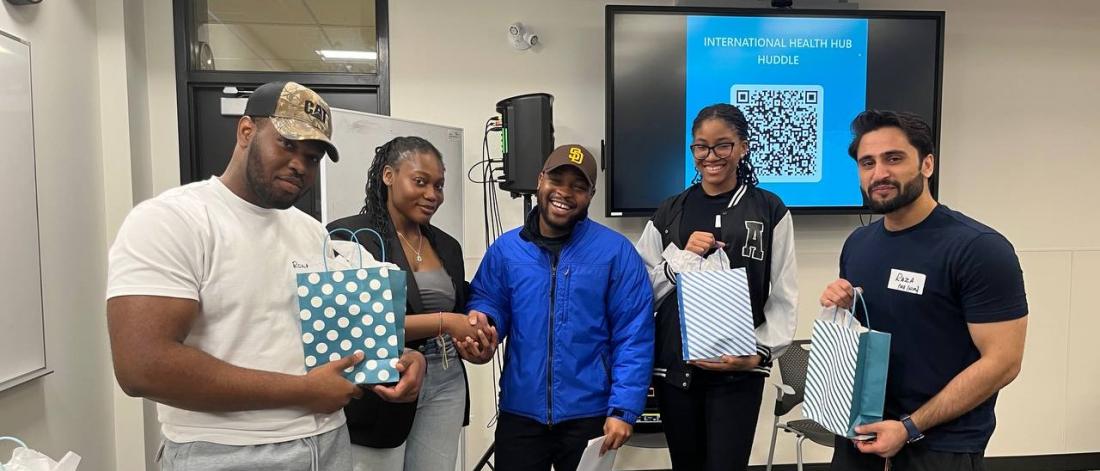
Thanks to the UM Strategic Initiatives Support Fund, Grants ranging from $500 to $3000 were awarded to applicant teams to help host regular and ongoing community building events or onetime events that aim to build community amongst members of minoritized, marginalized or other underrepresented groups at the University of Manitoba. Successful applicant teams participated in the Community Leadership Development Program (CLDP) to receive wrap around support in developing, implementing, and reflecting on their proposed community building initiative. Through CLDP programming, applicant teams learned how to work in ways informed by anti-oppression and EDIA values.
Applications for Grow Your Community Fund funding are no longer being accepted.
Current teams
Eleven teams received funding from the Grow Your Community Fund in the 2025/26 year. Learn more about some of the teams, their communities, and how you can participate below.
Indigenous Circles of Community Care
We are a group of helpers who recognize a need for community care by and for helpers using Indigenous ways of being, knowing, and doing.
Who can attend / participate?:
All students and workers in the helping professions who want to engage in Indigenous ways of being, knowing, and doing while offering and receiving community care.
How can people learn more?:
Email indigenouscirclescare@gmail.com.
Kaarigar
Kaarigar, an Urdu name for artisan or craftsperson, reconnects racialized women and students with ancestral crafting knowledge through hands-on learning with cultural knowledge holders, storytelling, and community building. It provides a restorative space for mindful making, supports participants' well-being, and centers creative practices cultivated by women. By pairing creative exchange with decolonial dialogue, the program fosters a deeper understanding of the cultural contexts that shape women's craft.
We will be hosting workshops and drop-in lunchtime crafternoons. Light refreshments provided.
Who can attend / participate?:
U of M students and broad community members who identify as racialized women are welcome!
How can people learn more?:
Follow @kaarigarcreate on Instagram for updates or contact us at kaarigar.community@gmail.com.
SPIRIT (Supporting Psychology Initiatives for Racialized Individuals and Trainees)
SPIRIT was created to promote the inclusion and engagement of racialized individuals in psychology. This year, with the support from the Grow Your Community Fund, we plan to host three events. The first will feature a panel of racialized psychology academics, the second will bring in a racialized clinical psychologist, and the third will provide an opportunity for racialized psychology graduate and undergraduate students to connect.
Who can attend / participate?:
Racialized psychology graduate and undergraduate students.
How can people learn more?:
Please follow @um.spirit on Instagram for updates.
The Circle We Belong
Our program invites students to join a new circle-based community designed to foster belonging, cross-cultural understanding, and mutual support. This program brings together international/newcomer students and Indigenous students to build relationships, learn about each other’s cultures and identities, strengthen social skills, and support one another in study, work, and campus life.
Our first four sessions will be held on the following dates:
- Wednesday, January 7, 2026 - 5-8 PM (The Circle of Identity)
- Wednesday, January 21, 2026 - 5-8 PM (The Circle of Land - Belonging)
- Wednesday, February 4, 2026 - 5-8 PM (The Circle of Culture)
- Wednesday, February 25, 2026 - 5-8 PM (The Circle of Hope)
All four sessions will take place on the University of Manitoba campus. Session venues will be confirmed and shared with registered participants.
There will be food and snacks provided during all sessions.
Who can attend / participate?:
We are selecting 15 students (undergraduate or graduate) who identify as international / newcomer or Indigenous. We will prioritize students who can commit to attending all four sessions.
How can people learn more?:
You can contact us via email to learn more or ask questions about our programs. Reach out to one of our team members, Linh Nguyen at: nguy114@myumanitoba.ca.
Deadline for registration is: 15 December 2025
Eligibility criteria
Definitions
As defined below by the Anti-Racism Task Force and Office of Equity Transformation:
Minoritized people
To make a person or specific group of people subordinated to a dominant group that claims themselves to the majority. It recognizes that groups of people can be minoritized regardless of demographic distribution, and that the process of claiming majority status and relegating others to minority status is embedded in the operation of power differentials in society
Marginalized people
Marginalized people refers to groups and communities that experience discrimination and exclusion (including social, political, economic exclusion) as a result of power relationships and hierarchies, and systemic inequities.
Under-representation
Under-representation refers to the insufficient or disproportionate representation of specific groups of people, in relation to demographic make up. Under-representation often includes people with visible and non-visible, physical or cognitive disabilities, age, gender identity and expression, sexual identity, income level, race, ethnicity, and marginalized religious groups.
Intersectionality
Intersectionality is a term associated with critical legal scholar Kimberlé Crenshaw that refers to the ways that racism, racial discrimination, harassment, and vilification are frequently linked, shaped, and informed by other structural forms of oppression linked to sex, gender, class, disability, and sexuality.
Eligibility criteria
- Applicants must apply as a team (minimum of 3 people), with a majority of members belonging to a shared student community that experiences minoritization, marginalization, or under-representation.
- Events or activities must support community-building or community organizing amongst members of minoritized, marginalized, or other under-represented groups. Intersectional student communities will be prioritized, whether as a new or emerging group, or as part of a gap in service within an established group.
- Organizers must commit to working in ways informed by anti-oppression and EDIA.
- At least one applicant must be a registered undergraduate or graduate student at the University of Manitoba at the time of application.
- At least one applicant must be intending to register for the term in which the event or activity will be implemented.
- Events or activities are typically small in scale (<50 people) and take place on a UM campus. Regular and ongoing community building events (of 3 or more) will be prioritized.
- Applicants must fulfill the Community Leadership Development Program requirements, including financial reconciliation and reporting.
- Applicants must have the time and capacity required to successfully implement their proposal.
- Events or activities must be completed by March 15, 2026.
Selection process
Timeline
The CLDP had two intake periods for the Grow Your Community fund; Summer 2025 and Fall 2025. The CLDP is not accepting any more applications for this year.
Grant evaluation criteria
While any applications that aim to build community amongst members of minoritized, marginalized, or other under-represented groups at the University of Manitoba were welcomed, the review committee prioritized distributing funding to applications based on the following evaluation criteria:
- Applications for regular and ongoing community building events (of 3 or more).
- Community building events that will start or take place in Fall 2025.
- Applications from intersectional student communities, whether as a new or emerging group, or as a part of a gap in services within an established group.
- Applications that have clearly defined goals.
- Applications that demonstrate a need/interest from the target student community for the proposed event(s).
- Applications that demonstrate sustainability/continuity of the community building beyond the proposed event(s), including how you will bring in more people to support a long term vision.
- Applications that demonstrate an awareness of and plan to address barriers to participation specific to the target student community.
- Applications that demonstrate connections or willingness to connect with like-minded student groups and admin units on campus.
- Applications that demonstrate alignment with a social procurement policy.
- Applications that do not have access to other funding sources.
- Applications from teams that have attended a Grow Your Community Fund - Fall Intake Info Session.
Review committee:
The review committee consisted of the following members:
- Anny Chen - Lead, Community Engaged Learning
- Ethan Wong - CLDP participant
- Geoffrey Pagcaliwagan - Coordinator, Student Experience and Development
- Madison Reed - Coordinator, Community Engaged Learning
- Sonja Stone - CLDP participant
How to apply
Thank you for your interest, but applications for the Grow Your Community Fund are no longer being accepted.
Application questions
In completing the form teams were asked the following:
- List the names of all team members applying for the grant.
- List the contact emails of all team members.
- Describe the minoritized, systemically marginalized, or underrepresented student community that the majority of your team members share.
- Provide the student number for one member of your team who is a current UM student.
- Can your team attend the required pre-scheduled weekly training sessions in full?
- Provide the student number for one member of your team who is intending to be a UM student during the time of your event(s).
- Identify at least two, 2-3 hour time slots that your team is regularly available and willing to commit to meet together outside of the scheduled training times.
- Are you applying for regular and ongoing community building event funding (3 or more events)?
- What is your group's name?
- Describe your proposal.
- Provide the total amount in dollars that you are requesting.
- Upload an outline of how you anticipate to use the funds using the budget template provided on the website.
- What other sources of funding could you access for this project?
- Who is doing work in this area on and off campus already? Who could help you with your project and in what way?