Get the information you need for academic planning and connect with experiences to develop the knowledge, skills and attributes that employers are seeking.

This resource is meant as a guide to provide suggestions throughout your time at university (refer to the Academic Calendar for a complete list of program requirements). Develop a plan and timeline that suits you best. Make intentional choices for your courses and work experiences.

  • Photo of Mark Rabkin
  • Student spotlight

    “Studying history initially sparked my interest in economics. I often found myself most engaged with the parts that discussed the country’s economy. I wanted to know more about how economic issues occur, how people and countries respond to them and what the repercussions would be.”

    Mark Rabkin, economics student

Economics at UM

The economy is important to all Canadians, and economics is the field of study that helps us understand our world: wages and employment, economic growth, productivity, wealth and poverty, government budgets and taxations, resources exploitation, business practices, inflation, recession and regional economic differences. As an economics student in the Faculty of Arts, you will study the history and current reality of these issues. The commitment of the department to a broad range of perspectives has stimulated the development of a variety of interdisciplinary programs including the global political economy and labour studies programs. The Department of Economics also offers joint honours programs in collaboration with the departments of mathematics and statistics.

Skills you will gain by studying ECONOMICS

  • A knowledge of the principles and techniques necessary to gain a sound understanding of the choices and problems facing us during our lifetime
  • The ability to collect, analyze and interpret data using statistical analysis, and make reasoned judgements on the basis of the available data
  • The ability to think critically and apply economic theory to develop innovative solutions to real-world issues
  • The ability to communicate effectively both verbally and in writing

Academic Success

Year 1 - 30 credit hours


Course requirements:
Refer to the Academic Calendar - be sure to contact the appropriate advisor for your chosen stream (Economics & Econometrics or Economics & Society).

ECON 1010 and ECON 1020 or ECON 1210 and ECON 1220

Honours (both streams) or Advanced Economics & Econometrics Stream only: plus MATH 1500 or MATH 1524

To do this year:

  1. Know the requirements for your degree. Meet with an academic advisor in the Faculty of Arts to help you plan your program.
  2. If you need academic support, visit the Math Help Centre or attend a Supplemental Instruction session through the Academic Learning Centre.

Year 2 - 60 credit hours


Course requirements:
ECON 2010, ECON 2020 and ECON 2040

Honours (both streams) and Advanced Economics & Econometrics stream only: plus ECON 2030

Refer to the Academic Calendar for additional course requirements—be sure to contact the appropriate advisor for your chosen stream (Economics & Econometrics or Economics & Society).

To do this year:

  1. Should you follow a 3-or 4-year plan? Meet with an academic advisor and career consultant to map out your options.
  2. When choosing a minor, take courses that will open opportunities.

Year 3 - 90 credit hours


Course requirements:
The following are prerequisites to key courses in your final year. Please ensure to schedule them accurately to complete your degree on time and meet with your academic advisor if you have questions.

Advanced Economics & Econometrics stream: ECON 3010, ECON 3020, and ECON 3040, plus additional required courses.

Advanced Economics & Society stream: ECON 3040 and ECON 3810, plus additional required courses.

Honours (both streams): see Academic Calendar for required courses.

To do this year:

  1. Meet with the Department of Economics for honours program approval.
  2. Meet with your co-op advisor (if applicable).
  3. Confirm eligibility to graduate with an academic advisor and declare intent to graduate in Aurora (3-year option).

Year 4 - 120 credit hours


Course requirements:
Advanced Economics & Econometrics stream: ECON 4822, plus additional required courses.

Advanced Economics & Society stream: see Academic Calendar for required courses.

Honours (both streams): see Academic Calendar for required courses.

To do this year:

  1. Meet with the department of economics for honours program approval.
  2. Meet with your co-op advisor (if applicable).
  3. Confirm eligibility to graduate with an academic advisor and declare intent to graduate in Aurora.

Career Tips

Year 1 - 30 credit hours 


Start planning your career:

  1. Meet with a career consultant to generate career ideas based on your interests, values, personality and skills.
  2. Research occupations that match your skills and interests.
  3. Set up a UM Connect account to view job postings and register for workshops and events.
  4. Set up your Experience Record, an official record of university-approved activities.

Year 2 - 60 credit hours


Make professional connections:

  1. Join the Career Mentor Program to learn from professionals.
  2. Attend career fairs to connect with employers.
  3. Become a Student Affiliate with the Canadian Economics Association or the Canadian Association for Business Economics.
  4. Attend the department of economics' weekly seminar series.

Market your skills: Develop your resumé and cover letter and refine your interview skills.

Year 3 - 90 credit hours


Investigate your career options:

  1. Look at sample job postings to ensure you have the qualifications upon graduation.
  2. Develop employability and essential skills sought by employers.
  3. Explore supports available to entrepreneurs for business development such as New Venture Championships through Stu Clarke Centre for Entrepreneurship, World Trade Centre Winnipeg, and the Manitoba Government.
  4. Create a LinkedIn profile to network with professionals.

Consider continuing your studies: Check out the Faculty of Graduate StudiesExtended Education or other academic institutions.

Year 4 - 120 credit hours


Start job search 9 months in advance: Contact Career Services to refine your job search and self-marketing strategies. You can visit the office up to 6 months after graduation.

If you are continuing on to graduate school: Finalize your application materials and required tests. Use the awards database to search for funding and awards to help finance your continuing education. Contact your department to find out how their awards deadlines are advertised.

Volunteer & Work Experience

Year 1 - 30 credit hours 


Link experiences to your career interests. Options include:

  1. Student groups including Arts Student Body Council, Toastmasters or UMSU.
  2. Volunteer for UM Orientation events to help welcome new students to campus while gaining experience or join the Student Leadership Development Program.
  3. Student work opportunities including Work-StudySTEP Services or Federal Student Work Experience Program.
  4. Experiential education opportunities such as UM Community Volunteers.

Year 2 - 60 credit hours 


Explore student research opportunities: Apply for a research assistant position or Undergraduate Research Award.

Gain practical experience by volunteering: Check out the Manitoba Legislative and United Way.

Find opportunities to market yourself: Become a Faculty of Arts Student Ambassador.

Earn while you learn: Consider applying to the Arts Co-operative Education program once you have completed 48 credit hours.

Year 3 - 90 credit hours 


Continue or start research: Participate in the Undergraduate Research Poster Competition.

Check out student job opportunities with: Canadian Border Services AgencyCanadian CED NetworkStatistics Canada, financial institutions and insurance agencies.

Search for job opportunities online: Check out Job BankFind My JobIndeed or other search engines.

Use your networks and connections: Inquire about unadvertised job openings (the "hidden job market").

Year 4 - 120 credit hours 


Ensure you have references in place: Ask your professor for a reference or a letter of recommendation if you're applying for graduate school.

Assess your resumé: Identify any gaps in experience and fill them through work placements or internships such as the Statistics Canada Recruitment Development Program or Manitoba Legislative Internship.

Cultural Opportunities

Year 1 - 30 credit hours 


Considering international opportunities? Visit the Language Centre and check out the International Centre website to learn more international opportunities for UM students.

Explore communities and cultures you want to work with: Visit Migizii Agamik, the International Centre or learn about local agencies via 211 Manitoba.

Year 2 - 60 credit hours 


Develop global career skills and expand intercultural learning: Consider Summer University at Warsaw School of Economics, an international service-learning program, My World Abroad or SWAP for a "working holiday".

Staying local? Check out Community Engaged Learning. Consider learning a new language and culture through the Language Partner Volunteer Program.

Year 3 - 90 credit hours 


Participate in the multicultural opportunities on campus: Participate in the Intercultural Development and Leadership Program, volunteer for the International Student Mentorship Program or take part in Graduation Pow Wow.

Year 4 - 120 credit hours 


Prepare to work in a multicultural environment: Visit Canada's National Research Centre for Truth and Reconciliation on campus and register for the Intercultural Leaders.

What do employers want?

Industries such as banking and financial services, business, government and insurance would value an economics major in combination with the employability skills that are highly sought after by employers. The include:*

  • Oral and written communication
  • Numeracy and data use
  • Critical thinking
  • Problem solving
  • Teamwork
  • Digital technology
  • Industry specific knowledge
  • Continuous learning

*Information has been adapted from Employability Skills 2000+ and Workplace Education Manitoba – Essential Skills.

Alumni stories

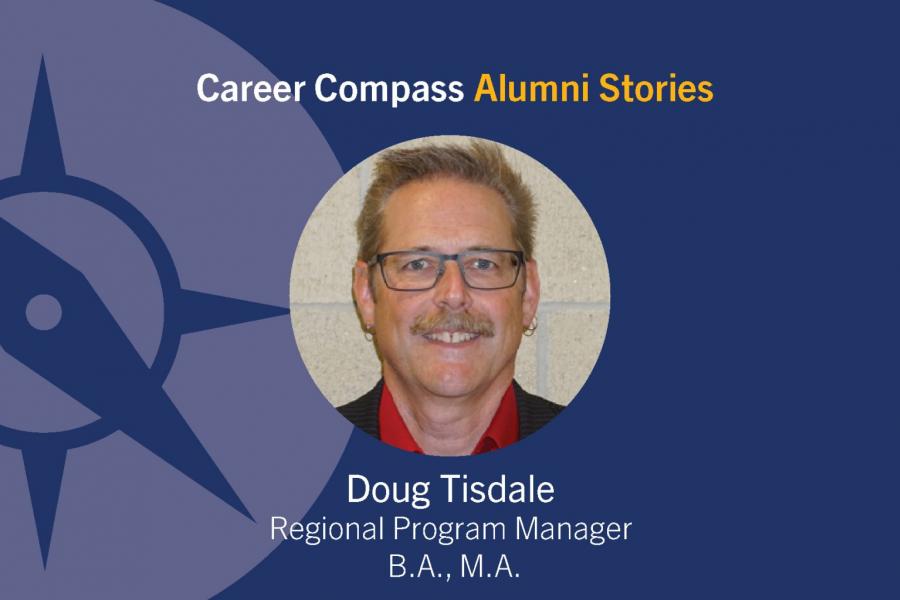
Career Compass Economics Alumni Story: Doug Tisdale, Regional Program Manager, B.A., M.A.

Doug Tisdale, B.A., M.A.

Doug Tisdale's job as a regional program manager with the federal government involves implementing new and existing programs in a corporate and/or operational environment. This includes leading a team of officers and dealing with human resources issues such as performance assessment, setting individual and team objectives, developing work plans, dealing with grievances, delivering disciplinary decisions as well as recognizing excellent achievements and contributions.

Read more about Doug Tisdale’s career path

Briefly, tell us about your job. What do you find most rewarding? What are your greatest challenges within this profession?

My job as a regional program manager with the federal government involves implementing new and existing programs in a corporate and/or operational environment. This includes leading a team of officers and dealing with human resources issues such as performance assessment, setting individual and team objectives, developing work plans, dealing with grievances, delivering disciplinary decisions as well as recognizing excellent achievements and contributions.

Some of my greatest challenges include working through competing interests of our various stakeholders and partners and gaining consensus in order to move initiatives forward. Additional challenges are generational issues as they relate to staffing and performance expectations. Continual organizational change within the federal government and within my specific agency also makes the work very challenging. As a manger, it is my responsibility to implement organizational changes, gain the support of my personnel and deliver results to internal and external clients while ensuring good governance and stewardship.

What experiences and activities helped you to map out your career pathway?

Diverse professional opportunities that arose within the federal government were the main influences on my career path. My profession as a public servant provided me with the opportunity to branch out and experience some very different occupations. This allowed me to pursue further education and develop expertise in areas that were previously unknown to me.

As a student, did you see yourself in your current career? What stayed the same and/or changed?

As an undergraduate student I did not really know what type of career I wanted to get into so I didn’t envision myself in my current career. After high school I was working full time in a science based job when I decided to pursue an education in economics. I began working for the federal government as a casual employee while still attending university.

As I was doing my graduate degree I knew I would probably stay with the federal government in some capacity, but I never envisioned working in my current department. Although my university degrees have not always been directly related to all positions I have held with the federal government, the skills and competencies I learned while attending university have definitely allowed me to succeed, especially as a regional manager with the federal government. I refer to oral and written communication skills, critical thinking, independent judgment and ethical decision making and a sound understanding of local, national and international issues.

What advice do you have for students who are interested in pursuing a degree in economics?

I would advise students to get to know their professors. Don’t be afraid to approach professors with questions, problems or issues. Professors are encouraged by and interested in students who take an active interest in learning and excelling in their field. Many of these educators will become your colleagues and mentors in the future.

What job search advice do you have for students and recent graduates?

Don’t discount any potential jobs without doing thorough research to determine exactly what is required and involved with the job. You may find a field to work in that isn’t exactly what you envisioned or studied in university but the skills and competencies you developed during your studies will serve you well and open up all kinds of opportunities you never considered.

Tell us a fun fact about your career path.

My career path was almost entirely unplanned. I seized opportunities as they arose and I took chances by moving into unknown positions because they provided me with challenging work, allowed me participate in continuous learning and ensured that my professional life always stayed fresh and interesting. One of the reasons I’ve stayed with my current department is because my daughter thinks my work is pretty cool! These are some of the reasons I volunteered to participate as a career mentor.


Career Compass Economics Alumni Story: Neil Duboff, Corporate Lawyer, B.A. (Hons), LLB

Neil Duboff, B.A. (Hons), LLB

Neil Duboff's practice in law allows him to help his clients understand the legal system and safely and efficiently structure their lives and businesses. It is rewarding for Neil to know that he can use my experience and training to make a difference.

Read more about Neil Duboff’s career path

Briefly, tell us about your job. What do you find most rewarding? What are your greatest challenges within this profession?

I practice law. This allows me to help my clients understand the legal system and safely and efficiently structure their lives and businesses. It is rewarding to know that I can use my experience and training to make a difference. The greatest challenge for me in the profession is when I meet lawyers who forget that the foundation of our career is helping clients.

What experiences and activities helped you to map out your career pathway?

My first degree from the University of Manitoba was an honours degree in economics. Through my studies I became interested in development economics and social causes. My practice working with Indigenous Canadians allows me to use my development tools from economics and law to assist first Canadians grow and overcome the economic and legal burdens they have faced over centuries.

As a student, did you see yourself in your current career? What stayed the same and/or changed?

When I was studying economics I had no plan on entering law school. When I was in law school I had no understanding how I could use my legal training to pursue my passion for social causes. What has changed for me is my passion to make Canada an economically strong and passionate country.

What advice do you have for students who are interested in pursuing a degree in law?

Speak to practicing lawyers about the work they do, the time commitment required and the stresses and benefits of being a lawyer. Try to visualize yourself being a lawyer and assess if this might be a life path you would find challenging and enjoyable.

What job search advice do you have for students and recent graduates?

Talk to lawyers and let them get to know you. Become more than a resumé – let the lawyers (the firm) know you as a person.

Tell us a fun fact about your career path.

Prior to entering law I worked as a bank manager. When I went back to law school the bank started Saturday banking and I was able to work as a manager of the central bank branch for Saturdays. On these days I got to be quite close to a number of customers. A number of these people went on to become politicians and leaders in the business community. When I started practicing these contacts from the bank became close clients of mine in my law.

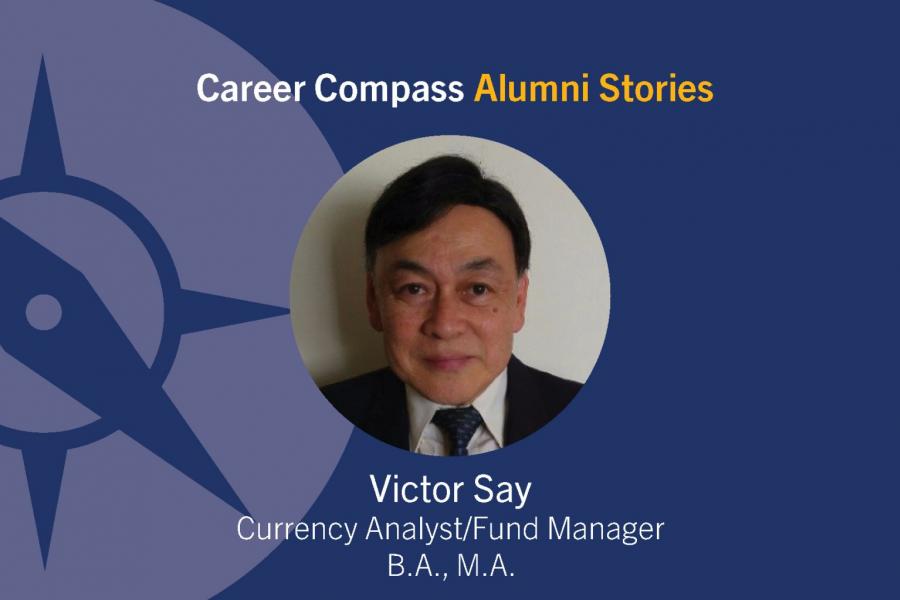
Career Compass Economics Alumni Story: Victor Say, Currency Analyst/Fund Manager, B.A., M.A.

Victor Say, B.A., M.A.

Victor Say is a currency analyst as well as a fund manager. The most rewarding part of Victor's job is making the right calls on the market and generating profits for clients.

Read more about Victor Say’s career path

Briefly, tell us about your job. What do you find most rewarding? What are your greatest challenges within this profession?

I am a currency analyst as well as a fund manager. The most rewarding part of my job is making the right calls on the market and generating profits for clients. The most challenging part is keeping abreast of the changes to the market and timing when to get in and out of the markets.

What experiences and activities helped you to map out your career pathway?

My late mother worked in a bank and often brought me to her office. That sort of mapped out what I wanted to do after graduation.

As a student, did you see yourself in your current career? What stayed the same and/or changed?

My mom worked in the current accounts department of the bank so I was leaning towards that. However, after taking courses in banking and financial markets, I realized that being a foreign exchange trader was more my cup of tea. I stayed on as an foreign exchange trader for 12 years then moved into private banking.

What advice do you have for students who are interested in pursuing a degree in economics?

I believe that an economics degree has equal opportunities to an engineering or commerce degree. The degree helps you to get your foot into the door but it’s your performance after that really matters.

What job search advice do you have for students and recent graduates?

During the late 1970s and early 1980s, there were decent job opportunities, but looking for them was somewhat challenging as we did not have the internet back then. My first job was as a treasury executive in a shipping company which I took because I believed it would open the door for me when applying for a banking job. True enough, an opportunity came up seven months later and I stayed in that industry since. So my advice is to take whatever job that comes your way as it will open the door for the one that your prefer.

Tell us a fun fact about your career path.

Initially I traveled a lot for work. I was sent to different branches throughout the world and met business leaders which helped further my career.

Campus resources and supports

Get one-on-one help

  • Meet with a career consultant

    Meet with a career consultant for a confidential discussion about your career goals, job search, resumé/CV and interview preparation.

    Contact Career Services at cs.receptionist@umanitoba.ca or call 204-474-9456 to make an appointment.

  • Talk to an academic advisor

    Talk to an academic advisor who will guide you to resources to help you make important decisions for your future. Advisors are specialized, often by program, faculty/school or unit.

    Find your advisor

Continue exploring

Select a Career Compass

Use Career Compass as a guide to develop a strong connection between your studies and your occupational choices. It will provide you with suggestions for academic and career planning specific to your program.

Advisors and Educators Guide

Contact us

Connect with the faculty

Department of Economics, Faculty of Arts
501 Fletcher Argue Building
15 Chancellors Circle
University of Manitoba (Fort Garry campus)
Winnipeg, MB R3T 5V6 Canada

204-474-9207

Connect with Career Services

Career Services
Room 474 UMSU University Centre
65 Chancellor's Circle
University of Manitoba
Winnipeg, MB R3T 2N2 Canada

204-474-9456
204-474-7516
Monday to Friday, 9:00 a.m. to 4:00 p.m.