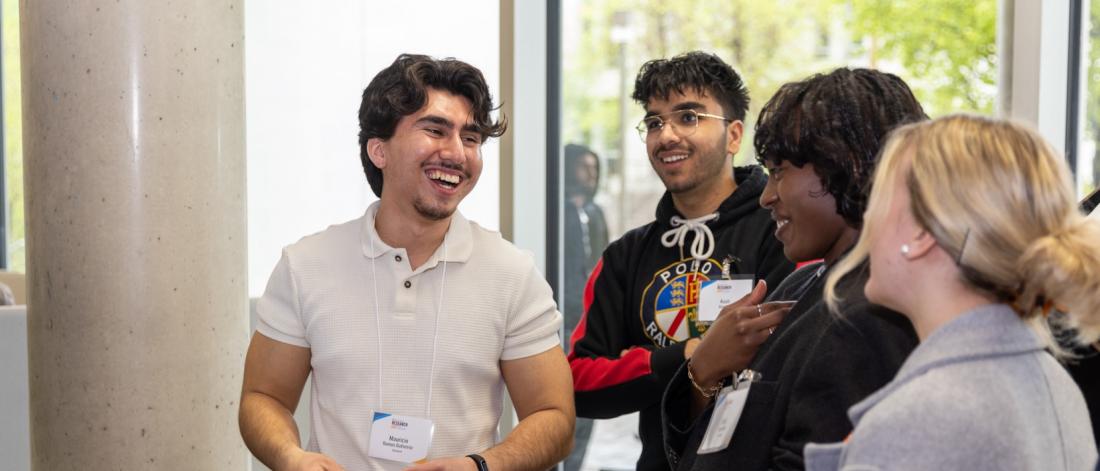
A group of research day partcipants laughing together

Research Day

On this page

Overview

  • UM faculty of Kinesiology and Recreation Management Research Day May 6 2026
  • Research Day 2026

    Join us for an exploration of sport, physical activity, recreation and leisure across the lifespan. Grounded in our strategic plan’s commitment to inclusive community health, we’re highlighting research that spans all abilities, cultures and life stages.

    Research Day 2026 will feature a Keynote from Dr. Lise Olsen and the annual FKRM poster competition. This year will also feature several breakout sessions with different experts discussing topics centred around the 2026 theme.

    Register today

Sessions

  • A headshot of Dr. Lise Olsen
  • Keynote speaker

    Dr. Lise Olsen

    Associate Professor, Faculty of Health and Social Development, School of Nursing, University of British Columbia
     

    Dr. Lise Olsen is an Associate Professor in the School of Nursing at the University of British Columbia, Okanagan.  She worked as an RN a variety of clinical settings, including orthopedics and community health. Olsen’s research career has focused on child and family health promotion with a more recent focus on inclusive and safe recreation for families of children living with neurodevelopmental disabilities, including autism spectrum disorders.

Breakout sessions

This year's Research Day will feature presentations from experts in a variety of fields. They will be discussing topics centred on this year's theme of sport, physical activity, recreation and leisure across the lifespan.

Morning breakout session 

1: New-to-Canada sport for life/Islamophobia and sport participation with Carolyn Trono, Dr. Richard Sylvester and Eve Sotiriadou.

2: Aging and the joy of movement with Dr. Stephanie Chesser, Dr. Cheryl Glazebrook and Maritel Centurion 

Afternoon breakout session

3: Indigenous approaches to physical literacy with Dr. Kathryn Morog 

4: The built environment as a lever to promote physical activity in large populations - Lessons from a pan Canadian research team with Dr. Jon McGavock, Isaak Fast and Nika Klaprat 

Poster presentations

2026 posters and presenters

The Acute Effects of Resistance Exercise on Sleep Quality and Quantity in University-Aged Students: A Randomized Crossover Study

Queen Oladele

Advisor: Dr. Stephen Cornish

This study examines the acute effects of a single session of moderate-intensity resistance exercise on sleep quality and quantity in university-aged students. Using a randomized crossover design, 32 participants will complete both an exercise and a non-exercise control condition. Objective sleep outcomes (e.g., sleep efficiency, total sleep time) will be measured using actigraphy, while subjective sleep quality will be assessed using the Leeds Sleep Evaluation Questionnaire. It is hypothesized that resistance exercise will improve sleep efficiency and other sleep parameters. Findings may inform practical, non-pharmacological strategies to improve sleep health in university populations.

Acute Muscle Swelling is Similar Across Regions Following Resistance Exercise at Short and Long Muscle Lengths

Rebecca Franklin

Advisor: Dr. Trisha Scribbans

Resistance training (RT) can induce region-specific hypertrophy, with RT at longer muscle lengths (ML) eliciting greater adaptations than short ML. Acute muscle swelling may help determine whether ML influences regional responses. Ten participants performed four sets of 10 repetitions of short- and long-ML cable curls (75 per cent one-repetition maximum, 30s rest) on contralateral arms. Ultrasonography assessed PRE- and POST-exercise muscle swelling across three regions. A 2x3 repeated-measures ANOVA on change scores (POST-PRE) revealed no significant main effects of ML or region, and no ML*region interaction (all p>0.05), suggesting that acute regional muscle swelling does not differ between short- and long-ML exercise.

An intersectional analysis of sex and income inequities in cardiac rehabilitation

Jacqueline Hay

Advisor: Dr. Todd Duhamel

We studied health equity in access to cardiac rehabilitation using an intersectional lens, focusing on how financial barriers and sex/gender together affect enrollment. Our analysis of enrollment rates across income levels and sex used the data from 5,569 referrals (2016‚ 2019) linked to area-level census income information. The lowest-income quintile enrolled less often than the highest-income group, and females enrolled less frequently than males. The largest gap was observed between low-income females and high-income males. These results underscore the importance of developing targeted strategies to improve access.

Between-Limb Force Symmetry Post-Anterior Cruciate Ligament Reconstruction: Navigating the Influences of Exercise Type and External Load

Zachary Carpenter

Advisor: Dr. Shaelyn Strachan

Chronic altered movement mechanics while strength training are commonly observed after anterior cruciate ligament reconstruction (ACLR). Consequentially, the affected limb's ability to produce and absorb force is diminished, eventually leading to significant differences in strength between limbs and increased risk of re-injury. There is considerable debate in the literature regarding optimal exercise selection for injured-limb restrengthening. 

Further, a major gap in research is determining how increased external resistance impacts the ability to load the affected limb. This is critical for practitioners to understand as many ACLR athletes who engage in activities that require extensive lower-limb force production must regain symmetrical limb strength under heavy loading schemes. This research seeks to determine the influences of different lower-limb exercise type and differing load intensities on affected-limb loading and re-strengthening. 

Breaking the Cycle: Counteracting Frailty Through Progressive Resistance Training in Older Adults: A Pre-Post Intervention Study

Edgar Galeano

Advisor: Dr. Rodrigo Villar

At least 1 in 4 older adults in Canada is experiencing frailty, drastic reductions in physical performance, early onset of fatigue, pain, discomfort and falls, limiting movement. 

Chronic underuse of body structures results in progressive atrophy and dysfunction, Exercise training is crucial for reversing deconditioning and counteracting frailty.

Progressive Resistance Training (PRT)  has the potential to ‚Üì frailty indicators of impaired mobility related to activities of daily living.

Compared to the pre-test, the 12-week PRT program demonstrated:

  • 71 per cent in the overall Frailty Index;
  • 18 per cent in Gait Speed
  • 10 per cent in Handgrip strength
  • 291 per cent in Physical activity level

Can Dietary Nitrites Mimic Exercise-Induced Neurovascular Adaptations via Myokine Pathways?

Jose Peralta-Huertas

Advisor: Dr. Stephen Cornish

Physical activity increases cerebral flow both in acute and chronic fashion.  One type of endogenous substance responsible for this is myokines, such as Brain-Derived Neurotrophic Factor, Interleukin 6, Irisin, Cathepsin B, and the Vascular Endothelial Growth Factor. These myokines are involved in adaptation of neural tissue to exercise and cognition. Nitric oxide has also been found in increasing brain circulation. 

Extensive research has signaled that dietary sources of NO like beetroot juice can improve central nervous perfusion, mimicking NO effects on neuronal tissues.  This proposal aims to explore if dietary sources of NO (nitrites) can activate myokines pathways at rest. 

The Effects of transcutaneous Spinal Electrostimulation on Cardiovascular and Respiratory Systems in those living with Spinal Cord Injury: A Systematic Review

Sara Petkau 

Advisor: Dr. Rodrigo Villar and Dr. Kristine Cowley

This study systematically reviews the current literature on the effect of transcutaneous spinal electrostimulation (TSES) on cardiorespiratory outcomes in those living with a spinal cord injury (SCI). Using a structured search strategy across several databases, findings indicate that TSES helps normalize heart rate (HR) and blood pressure (BP) responses while respiratory outcomes remain mixed. Reported adverse effects are minimal, supporting the safety of TSES.

Effects of Water Immersion on Athlete Recovery

Conor Dowdell

Advisor: Dr. Stephen Cornish

Water Immersion has become an emerging technique to promote skeletal muscle recovery from resistance exercise. Specifically, both hot and cold water have been utilized as recovery techniques to stimulate the skeletal muscle recovery process. The aim of this study is to determine if either hot or cold-water recovery conditions presents greater benefits to neuromuscular recovery after an acute bout of skeletal muscle damage using Countermovement vertical jump (CMVJ), 20-metre sprint testing and subjective muscle soreness (VAS) ratings to determine changes pre and post recovery technique. This repeated measures randomized cross-over design will include 48 participants with inclusion requirements being 14 and 17-year-old youth athletes.

Enhancing Movement Initiation Through Sensory Cue-Feedback Pairings in Sequential Reaching Tasks

Peyton Clark

Advisor: Dr. Cheryl Glazebrook

This study investigated how brief auditory and vibrotactile stimuli influenced planning and control of one and two-target movements. Augmented sensory cues and feedback were manipulated at movement initiation (as the go-signal) and at target one acquisition (as feedback). Eleven young adults (20-32 years old) used a custom stylus to perform goal-directed reaching movements to one (OT) or two targets (TT) displayed on a touchscreen. Participants completed 20 trials per condition in a counterbalanced order. Each block consisted of OT or TT movements and one sensory condition (Auditory-Auditory-AA; Auditory-Vibrotactile-AV; Vibrotactile-Auditory-VA;Vibrotactile-Vibrotactile-VV). These findings underscore the importance of optimizing cue-feedback pairings to support efficient performance.

Exploring Inclusive Practices in Physical Education in Jamaica

Naheel Brown Legister

Advisor: Dr. Leisha Strachan

Physical Education (PE) in Jamaica is cited as one of the drivers to promoting healthy lifestyle practices in schools. It is a mandatory course in the National Standards Curriculum (NSC) from grades 1-9 in general education government schools. There is no evidence of adapted physical activities in the NSC. Using a phenomenological approach, this qualitative research aims to examine the current trends and practices of inclusion in PE in secondary schools in Jamaica, through the perspectives of key stakeholders such as educators, administrators, and students with mobility impairments. The study is embedded in the Ecological Systems and Socio-Cultural theories, within a constructivist worldview, and the results will be recommended for use by relevant stakeholders to ensure inclusive learning environments in PE suitable for all learners.

ICC Analysis: Reliability of Ultrasound Muscle Stiffness Measurements

Melina Kaluzny

Advisor: Dr. Trisha Scribban

Accurate measurements are fundamental to ultrasound research. While professional sonographers are expected to maintain consistent measurements, non-certified researchers must demonstrate precise scanning skills before collecting data for clinical study. 

This study utilized Intraclass Correlation Coefficient (ICC) analysis to evaluate the intra-rater reliability of a novice researcher measuring stiffness of the serratus anterior (SA) and trapezius: upper (UT), middle (MT), and lower (LT). Results indicated good reliability for the MT (0.85), LT (0.85), moderate reliability for the SA (0.51), and poor reliability for the UT (0.42). Findings establish the necessary baseline of measurement consistency required for completion of a master's thesis.

Influence of Post-Activation Performance Enhancement on Lower Limb Muscles After Conditioning Activities Amongst Selected Exercise Participants: Randomized Controlled Trial

Israel Abejoye

Advisor: Dr. Stephen Cornish

The study explored two different tempos with a control condition. The study explored how different conditioning activity tempos with the same load, but different number of repetitions can influence neuromuscular function. The study informs researchers and practitioners across the sports sector of the influence of slow and fast tempos which may be related to performances in their sport. Consequently, practitioners can concentrate on the most pertinent tempo that produces better performance, thereby producing the best training adaptations throughout successive training blocks. 

Menopausal Hormone Therapy, 24-Hour Movement Behaviours, and Cardiovascular Risk in Postmenopausal Women: A cross-sectional secondary data analysis of WARM Hearts cohort study

Jamie Alexiuk

Advisor: Dr. Todd Duhamel

Menopause is associated with increased CVD risk and the onset of symptoms that interfere with quality of life. Menopausal hormone therapy (MHT) is prescribed to relieve symptoms, but its cardiovascular safety has been debated. Conversely, 24-hour movement behaviours (moderate-to-vigorous physical activity [MVPA], sedentary behaviour, and sleep) are established predictors of cardiovascular health. This study addresses a research gap: no studies have compared these movement behaviours to MHT in explaining cardiovascular risk.

MHT was not associated with clinically significant cardiovascular risk and is likely safe. MVPA was more important for promoting and protecting cardiovascular health and should therefore be prioritized.

The Mental Health Outcome in Adolescents with Type 1 Diabetes. A Systematic Review and Meta-analysis

Eiva Fallahasady

Advisor: Dr. Jon McGavock

Adolescents living with Type 1 Diabetes (T1D) face daily challenges in balancing insulin, food, and physical activity (PA) which place burden on their mental health. Although in previous studies the importance of PA on mental health outcome in general population has been clearly demonstrated, there are few evidence to measure association between mental health outcomes and PA in adolescent living with T1D. 

Therefore, the aim of this systematic review is to synthesize all previous studies and research to identify the prevalence of the mental health outcome among adolescents with T1D in comparison with their peer and examine whether PA mediate the relationship between the mental health outcome and T1D.

Passion Across Time: Age Differences in the Number and Types of Passion

Md Rony Hossan

Advisor: Dr. Ben Schellenberg

This study investigated the relationship between age and the passion for individuals' favourite activities. A sample of 592 participants (aged 18‚ Äì85 years, M=51.56, SD= 17.02; 54 per cent women) completed online surveys measuring both the passion for their favourite activities and the number of passions in their lives. The findings demonstrated that age was significantly and negatively associated with the number of passions.

Additionally, age was found to be significantly and negatively related to obsessive passion for each favourite activity. Our study suggests that older people are less obsessively passionate about their favourite activities than younger people.

Prevalence of Groin Pain and Hip Adduction Strength in Adolescent Male Ice Hockey Players

Jakob Louka

Advisor: Dr. Dan Ogborn

Hip and groin problems are extremely common in ice hockey players, but little is known about their prevalence in adolescents. This study quantified groin pain in adolescent male ice hockey players and examined relationships between hip adduction strength, groin pain, anthropometric measures, age, and playing position. A total of 119 U15 and U18 players completed the 5SST and bilateral hip adduction strength testing. Overall, 86.6 per cent reported minimal pain, 12.6 per cent reported moderate pain, and 0.8 per cent reported severe pain. No significant associations were found between 5SST scores and hip adduction strength, suggesting strength may not predict groin pain in this population.

Quantifying Age-Related Changes in Spatial Muscle Activation of Trapezius During Arm Elevation

Hadi Fahrvandi

Advisor: Dr. Trisha Scribbans

Aging alters neuromuscular control, yet the spatial organization of muscle activation of the three portions of the trapezius during functional tasks remains poorly understood. 2-dimensional statistical parametric mapping, modified entropy, and the barycentre analyses across arm elevation ranges were used to compare younger (N=28) and older (N=24) adults. Results revealed that older adults demonstrated higher muscle excitation compared to younger adults during arm elevation. Furthermore, Age-related differences in modified entropy were range-dependent and observed only in the upper trapezius. No significant differences were found in the barycenter of the muscle activation, indicating comparable spatial distribution of activation despite differences in activation magnitude.

Rate of Perceived Effort Does Not Differ Training at Short and Long Muscle Lengths

Clive Guitarte

Advisor: Dr. Trisha Scribbans

While resistance training (RT) at longer muscle lengths (LML) elicits greater hypertrophy, it may also elicit higher rate of perceived effort (RPE) compared to training at shorter muscle lengths (SML). This study examine differences in RPE during elbow flexor RT at both SML and LML. Using a within-subject design, 20 participants performed four sets of 10 repetitions of cable curls at 75 per cent one-repetition maximum, with 30-seconds of rest between sets. A paired samples t-test revealed no significant differences in RPE between SML or LML (t (19) = 2.06, p=0.053, d=0.461). These results suggest a dissociation between muscle length and perceived effort during resistance training.

The relationship between counter movement vertical jump performance and the myocardial performance index of university level athletes in season

Braeden Smith

Advisor: Dr. Stephen Cornish

This research study will look to examine the degree of association between neuromuscular performance from counter movement vertical jumps and the myocardial performance index through seismocardiography in university athletes across various sports. 40 University of Manitoba athletes (20 male and 20 female) will test counter movement vertical jumps and cardiac measurements 2-3 times a week before off-field training sessions during their season. Jumps will be measured using VALD force plates and cardiac metrics will be measured using the Recordis Cardiac Sensor. 

The Role of Mattering in Girls Sport Participation

Hayley Jade

Advisor: Dr. Mandi Baker

From a KPER 4600 Directed Study, this project has explored how mattering shapes girls' experiences in sport environments and whether feeling that they matter helps them stay in sport. I looked at different promotional materials about girls and women in sport, pulling key quotes from the documents and letting our five key themes emerge. 

From these quotes, I identified several factors that play a role in the overall sport environment, such as relationships, the culture around sport, and the importance of role models, etc. Rather than offering final answers, the goal was to open up conversations surrounding the sport environment and culture as an overlooked pillar in understanding why girls drop out of sport.

Self-Compassion and Performance Outcomes in Competitive Curlers

Abigail Storey

Advisor: Dr. Shaelyn Strachan

This prospective study examines whether self-compassion predicts adaptive outcomes in competitive curlers. Self-compassion, comprising self-kindness, mindfulness, and common humanity, may help athletes manage challenges and enhance performance and well-being. Seventy-seven adult curlers will complete baseline measures of self-compassion at the start of the season and follow-up assessments of performance, motivation, well-being, and self-criticism at the end of the season. Objective performance will be measured using coach-recorded statistics. Regression analyses will test whether baseline self-compassion predicts outcomes over time. Findings aim to address gaps in the literature by linking self-compassion to actual performance and informing interventions to support athletes‚ psychological and performance outcomes.

Self-talk in competitive sport

Estefania Garcia Reyes

Advisor: Dr. Leisha Strachan

Self-talk in sports appears to serve several cognitive and behavioural functions that are related to performance, emotions, and self-regulation. This research will seek to explore athletes' experiences in an uncontrolled and competitive environment to better understand how self-talk changes before, during and after competition in individual sports. 

Semi-structured and open-ended interviews with a naturalistic video-assisted approach with athletes from individual sports will be used. This study could offer insights into athletes' lived experiences with self-talk in competitive settings and may serve as a valuable resource for athletes, coaches, and practitioners in developing strategies that could help redirect self-talk towards more constructive patterns, promoting positive experiences and healthier practices during competition.

Sport DNA: The Blueprint for Safer, High-Performance Sport

Craig Hillier

Advisor: Dr. Leisha Strachan

The Future Commission of Canada (2026) determined that the Canadian sports landscape is in crisis and requires urgent stabilization and decisive action. This Sport DNA framework offers a stable system for action research aimed at creating a safer, more structured, high-performance sports culture by balancing performance and well-being. 

By integrating safeguarding, culture, and performance, this framework enables a deeper exploration of organizational sport culture and leadership practices that directly shape the sport environment. Embracing values and behaviours at the core of a healthy sport culture will elevate athletes and sport organizations. This conceptual framework is a blueprint for a more sustainable sport system.

Faculty of Kinesiology and Recreation Management undergraduate, Masters and AHS PhD students are invited to participate in the annual poster presentations to display and discuss their research.

Students have the option to enter the judged poster competition or present in the non-judged showcase.

Deadline:

Final deadline to register is April 22 (free poster printing included).

Poster showcase

The poster showcase is for students who want to display and discuss their poster but do not want to be entered into competition judging. Students showcasing their posters are expected to stand by the poster for the presentation period and answer questions audience members might have.

Poster competition

Contest Information:

Students are to prepare a 3-5 minute talk about their research. Judges will ask presenters questions, and after their deliberations, they will select the winners based on content, quality of research, originality and presentation. The competition will be held after lunch, and presenters must be present to stand with their posters.

Prize Categories:
•    First, second and third place awards for Master’s winners
•    First, second and third place awards for PhD winners
•    First place award for FKRM Undergraduate winner

Schedule

TimeEventLocation
8:30 a.m.Registration and refreshmentsAgora
9:00 a.m.Opening remarksAgora
9:20 a.m.Keynote with Dr. Lise OlsenAgora
10:30 a.m.Breakout session
1: New-to-Canada sport for life/Islamophobia and sport participationAgora
2: Aging and the Joy of movement274 Multipurpose room
11:45 a.m.LunchApplied Research Centre reception
12:00 p.m. - 12:45 p.m.Mentorship session with Dr. Lise Olsen220 ALC
1:00 p.m.Poster competitionAgora
2:45 p.m.Breakout session
3: Indigenous approaches to physical literacy220 ALC
4: The built enviroment. as a lever to promote physical activity in larger populations - Lessons from a pan-Canadian research teamAgora
3:45 p.m.Awards presentationsAgora
4:00 p.m.ReceptionAgora