Get the information you need for academic planning and connect with experiences to develop the knowledge, skills and attributes that employers are seeking.

This resource is meant as a guide to provide suggestions throughout your time at university (refer to the Academic Calendar for a complete list of program requirements). Develop a plan and timeline that suits you best. Make intentional choices for your courses and work experiences.

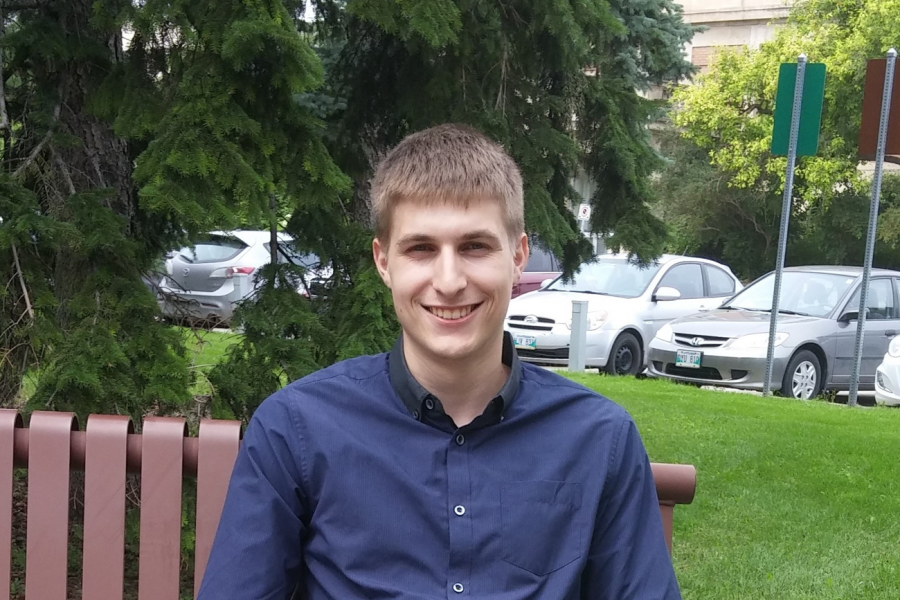
  • Photo of Ben Bawdon
  • Student spotlight

    “Global political economy requires an open mind and a willingness to be challenged. The intensity and wide content can be overwhelming and difficult, but is extremely satisfying to achieve in the end.”

    Ben Bawdon, global political economy student

Global Political Economy at UM

Social, political, ecological and economic issues are inseparable. Multiple perspectives and the ability to connect and synthesize them are needed to grapple with contemporary, complex issues. The multi-faceted global political economy program will present you with a balanced and innovative way to deepen your understanding of global political and economic relations.

Global political economy is an interdisciplinary program offered by five different departments: history, sociology, economics, anthropology and political studies. Faculty from each department have collaborated to create an exciting degree program that will prepare you to better understand the world, to bridge local issues and global forces and to become effective, collaborative actors beyond the walls of the university.

Skills you will gain by studying GLOBAL POLITICAL ECONOMY

  • The ability to understand and define global political and economic relations
  • The ability to analyze current and historical events from a social, political, ecological and economic perspective
  • The ability to think critically and develop innovative solutions to complex global issues
  • The ability to communicate effectively both verbally and in writing

Academic Success

Year 1 - 30 credit hours


Course requirements:
6 credit hours from HIST 1370HIST 1380, HIST 2730, HIST 2732, and HIST 2734ECON 1010 and ECON 1020 (or ECON 1210 and ECON 1220) and GPE 1700 or GEOG 1700

Advanced and Honours: all requirements listed above plus POLS 2602 

To do this year:

  1. Know the requirements for your degree. Meet with an academic advisor to help you plan your degree. Meet with the global political economy program coordinator to learn more about the program.
  2. Take SOC 1000 and ANTH 1220 as electives
    to get the prerequisites for upper level sociology and anthropology courses.

Year 2 - 60 credit hours


Course requirements:
Refer to the Academic Calendar for the requirements in your program. 

To do this year:

  1. Go to the Faculty of Arts Student Services Office to declare your major in person prior to registration..
  2. Take POLS 2502 as an elective to get the prerequisite for upper level political studies courses.
  3. Consider choosing a second language for your minor to enhance your employability prospects upon graduation.

Year 3 - 90 credit hours


Course requirements:

General: Refer to the Academic Calendar for course requirements in your program.

Advanced: Refer to the Academic Calendar for course requirements in your program.

Honours: Refer to the Academic Calendar for course requirements in your program. 

To do this year: Confirm eligibility to graduate with an academic advisor and declare intent to graduate in Aurora (3-year option).

Year 4 - 120 credit hours


Course requirements:

General: Refer to the Academic Calendar for course requirements in your program.

Advanced: Refer to the Academic Calendar for course requirements in your program.

Honours: Refer to the Academic Calendar for course requirements in your program.

To do this year: Confirm eligibility to graduate with an academic advisor and declare intent to graduate in Aurora.

Career Tips

Year 1 - 30 credit hours


Start planning your career:

  1. Meet with a career consultant to generate career ideas based on your interests, values, personality and skills.
  2. Research occupations that match your skills and interests.
  3. Set up a UM Connect account to view job postings and register for workshops and events.
  4. Set up your Experience Record, an official record of university-approved activities.

Year 2 - 60 credit hours


Make professional connections:

  1. Join the Career Mentor Program to learn from professionals.
  2. Attend career fairs to connect with employers.
  3. Become a student affiliate with the Political Economy of the World System (PEWS).
  4. Develop professional connections with professors by applying for an Undergraduate Research Award.

Market your skills: Develop your resumé and cover letter and refine your interview skills.

Year 3 - 90 credit hours


Investigate your career options:

  1. Look at sample job postings to ensure you have the qualifications upon graduation.
  2. Develop employability and essential skills sought by employers.
  3. Explore supports available to entrepreneurs for business planning including the Stu Clarke Centre for Entrepreneurship, World Trade Centre Winnipeg, and the Manitoba Government.
  4. Create a LinkedIn profile to network with professionals.

Consider continuing your studies: Check out the Faculty of Graduate StudiesExtended Education or other academic institutions.

Year 4 - 120 credit hours


Start job search 9 months in advance: Contact Career Services to refine your job search and self-marketing strategies. You can visit the office up to 6 months after graduation.

If you are continuing on to graduate school: Finalize your application materials and required tests. Use the awards database to search for funding and awards to help finance your continuing education. Contact your department to find out how their awards deadlines are advertised.

Volunteer & Work Experience

Year 1 - 30 credit hours


Link experiences to your career interests. Options include:

  1. Student groups including Global Political Economy Students’ Association and Arts Student Body Council.
  2. Volunteer for UM Orientation events to help welcome new students to campus while gaining experience.
  3. Student work opportunities including Work-StudySTEP Services or Federal Student Work Experience Program.
  4. Experiential education opportunities such as UM Community Volunteers and the Community Action Poverty Simulation.

Year 2 - 60 credit hours


Explore student research opportunities: Apply for a research assistant position or Undergraduate Research Award.

Gain practical experience by volunteering: Check out Canadian Red CrossManitoba LegislativeUNICEF or volunteer abroad through the AIESEC Global Citizenship program.

Watch for the new GPE Field Placement course offered in 2021* Register for this course to gain valuable work experience and networking opportunities in GPE. The GPE Field Placement course is offered every second year. Students are placed with community, labour, non-profit, and public sector organizations, where they get valuable research-based work experience and network connections.

Find opportunities to market yourself: Become a Faculty of Arts Student Ambassador or join the Student Leadership Development Program.

Year 3 - 90 credit hours


Continue or start research: Participate in the Undergraduate Research Poster Competition.

Watch for the new GPE Field Placement course offered in 2021. Register for this course to gain valuable work experience and networking opportunities in GPE. The GPE Field Placement course is offered every second year. Students are placed with community, labour, non-profit, and public sector organizations, where they get valuable research-based work experience and network connections.

Check out student job opportunities with: Canadian Border Services AgencyGlobal Affairs Canada and UMSU.

Search for job opportunities online: Check out DevexMy World AbroadJob BankFind My JobIndeed or other search engines.

Use your networks and connections: Inquire about unadvertised job openings (the "hidden job market").

Year 4 - 120 credit hours


Ensure you have references in place: Ask your professor for a reference or a letter of recommendation if you're applying for graduate school.

Find opportunities to market yourself: Present your research at the CSA Annual Conference or submit an article to the CCJA Justice Report.

Assess your resumé: Identify any gaps in experience and fill them through volunteering, work placements or internships such as the International Youth Internship ProgramManitoba Legislative Internship Program or Embassy of Canada’s Internship Program.

Cultural Opportunities

Year 1 - 30 credit hours


Considering international opportunities? Visit the International Centre to learn about international opportunities for UM students.

Explore communities and cultures you want to work with: Visit Migizii Agamik, the International Centre for Students or learn about local agencies via 211 Manitoba.

Year 2 - 60 credit hours


Develop global career skills and expand intercultural learning: Consider an international student exchange or Travel Study program, UNICEF Internship ProgrammeCanada World YouthMy World Abroad or SWAP for a "working holiday".

Staying local? Check out the WUSC Student Refugee Program or Community Engaged Learning. Practice your use of additional languages through the Language Partner Volunteer Program.

Year 3 - 90 credit hours


Participate in the multicultural opportunities on campus: Participate in the Intercultural Development and Leadership Program, volunteer for the International Student Mentorship Program or take part in Graduation Pow Wow.

Year 4 - 120 credit hours


Prepare to work in a multicultural environment: Visit Canada's National Research Centre for Truth and Reconciliation on campus and register for the Intercultural Leaders program through the International Centre.

What do employers want?

Industries such as business, community development, government and policy development would value a global political economy major in combination with the employability skills that are highly sought after by employers. These include:*

  • Oral and written communication
  • Critical thinking
  • Problem solving
  • Teamwork
  • Numeracy and data use
  • Digital technology
  • Industry specific knowledge
  • Continuous learning

*Information has been adapted from Employability Skills 2000+ and Workplace Education Manitoba – Essential Skills.

Alumni Stories

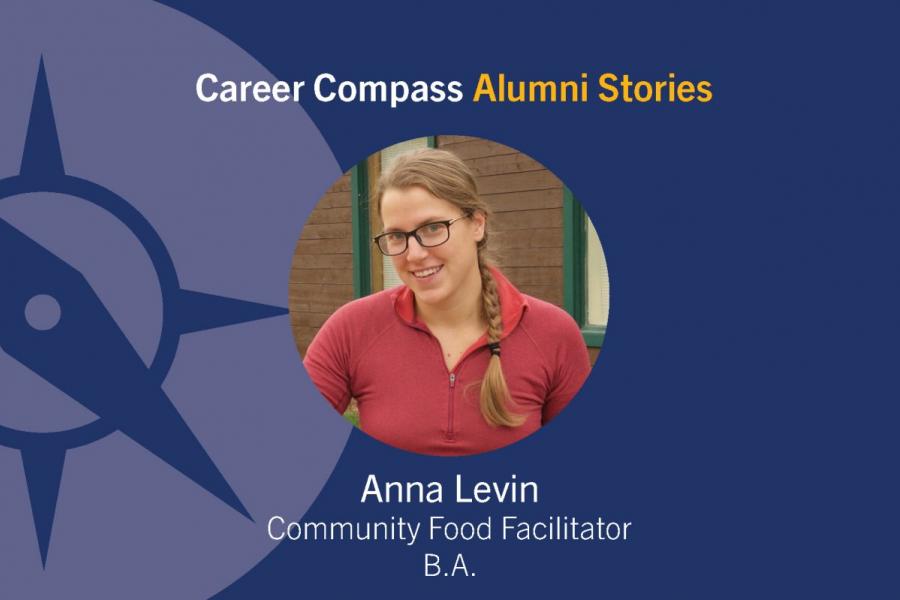
Career Compass Global Political Economy Alumni Story: Anna Levin, Community Food Facilitator, B.A.

Anna Levin, B.A.

Anna Levin is a community food facilitator at Food Matters Manitoba. As part of this charitable organization, Anna and her team work towards ensuring good food for all Manitobans.

Read more about Anna Levin's career path

Briefly, tell us about your job. What do you find most rewarding? What are your greatest challenges within this profession?

I am a community food facilitator at Food Matters Manitoba. As a charitable organization, we work towards ensuring good food for all Manitobans. There are many parts of our city and province where there are barriers keeping people from eating well. My job encompasses a wide range of things that aim to address those barriers, from running direct programming in communities (like kids cooking classes or gardening workshops) to behind the scenes support for community members who are running their own projects (such as helping with evaluation or sourcing funds and materials). I work in the city of Winnipeg and travel to Cross Lake and Fox Lake in northern Manitoba to support projects in those communities.

The most rewarding part of my job is the connections and relationships I’ve built. It’s amazing to work with kids and see them develop the skills and confidence to be able to prepare a meal. I have also met some really incredible people on my trips up north and have learned so much from them. There’s nothing more rewarding than seeing a project come together and witnessing the impact that it has. On the other hand, one of the big challenges of the job is how hard it can sometimes be to get a project started. Another challenge in my profession is lack of job security. Every project is dependent on funding and it can be stressful living from contract to contract.

What experiences and activities helped you to map out your career pathway?

I was always passionate about social justice and world issues and always wanted a career related to that. After high school, I took a year off and travelled to Mexico and Central America. Seeing the disparity in different parts of the world had a lasting impact on me. It solidified my desire to pursue a career where I could help make positive changes in people’s lives.

In university, I explored a couple of professional programs, but neither of them felt like the right fit. I was drawn to the global political economy program because it is so broad and combines different subjects. Writing my major research paper on community economic development was when I knew for sure that I wanted to work in the field of community development.

Another impactful experience in university was getting involved with the student garden. It was my first experience with gardening and I made some strong connections with students from other fields such as city planning and agriculture. I gained an understanding of food issues from a lot of different perspectives and also the tremendous power of food as a community building tool.

As a student, did you see yourself in your current career? What stayed the same and/or changed?

As I already mentioned, I have always wanted to make a positive difference in people’s lives and that idea stayed with me throughout my education and career, but how I go about doing it has changed. I started university thinking I wanted to be a nurse, then switched to engineering after one term and then decided that wasn’t for me either. The next year I went into the GPE program because I liked the idea of keeping my options open by learning about a wide variety of subjects. I also liked the ‘global’ aspect of the degree because I thought that I might like to work in international development or international affairs.

By the end of my degree, I had less interest in working overseas, having learned so much about the issues and interesting initiatives going on here at home. My interest shifted to food as a community building tool, and that’s how I ended up where I am now. So while I am still in the field of community development, and still working to help make positive changes in the lives of individuals and communities, the way that I’m interested in doing that has definitely changed over time.

What advice do you have for students who are interested in pursuing a degree in global political economy?

In retrospect, I definitely wish I had complemented the degree with more practical experiences. I think having had summer jobs in a related field or even volunteering would have helped a lot when I was looking for work after graduation. It would’ve helped in terms of having experience on my resumé, but also in terms of having connections in the small non-profit community. It also might have helped with the shock of landing in a ‘real life’ community development role if I had been exposed to some of the challenges that come with the work before hand, rather than just the theory. So, my advice would be to try to think about what it is you’re interested in doing and find some ways to get involved in that work early on.

What job search advice do you have for students and recent graduates?

Keep an open mind and look for opportunities in unexpected places. I applied for every job I could find that was even slightly related to what I wanted to be doing. My first job was working at the Boys and Girls Club of Winnipeg and I was disappointed that I hadn’t been able to find a more degree-related job. But I saw how the Boys and Girls Club job could be a bridge to that kind of job, drawing on the experience I did have, but also giving me a chance to develop a lot of new skills, so I took it even though it wasn’t my first choice. And I ended up loving it and staying with the agency for 3 years, growing into a more challenging position that was even closer to what I wanted to be doing. It was an incredible learning experience that totally changed my perspective on a lot of things. So – you never know what surprising jobs may turn into great opportunities.

Tell us a fun fact about your career path.

The scariest (career) choice I ever made was quitting my full time, permanent job with benefits at the Boys and Girls Club for a 3 month contract with a tiny little food related organization called Fruit Share. Nobody could understand why I did it! But that was how I made the leap from the world of youth work to the world of food security work, and it paid off in the end. A year later, when I applied for my current job at Food Matters Manitoba, it was my experience at Fruit Share that put me in the running for that position. So I don’t think I’d be where I am today if it wasn’t for that risk.

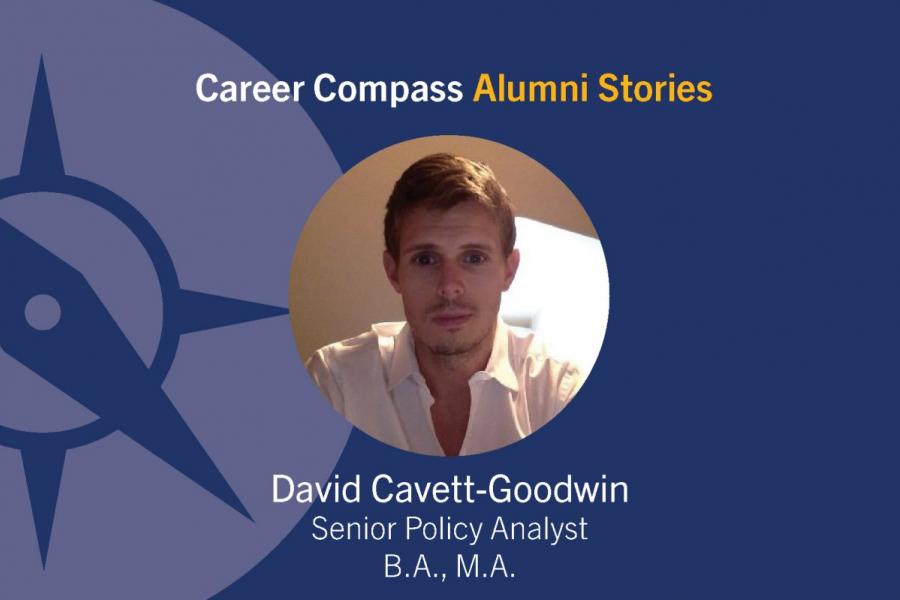
Career Compass Global Political Economy Alumni Story: David Cavett-Goodwin, Senior Policy Analyst, B.A., M.A.

David Cavett-Goodwin, B.A., M.A.

David Goodwin is a senior policy analyst with the Department of Labour, Government of Alberta. David leads a team that supports the development of a labour market information and intelligence (LMI2) system to help government, industry and public make more informed decisions about labour market policy/programming, workforce planning and possible careers.

Read more about David Cavett-Goodwin's career path

Briefly, tell us about your job. What do you find most rewarding? What are your greatest challenges within this profession?

I am a senior policy analyst with the Department of Labour, Government of Alberta. I lead a team that supports the development of a labour market information and intelligence (LMI2) system to help government, industry and public make more informed decisions about labour market policy/programming, workforce planning and possible careers.

What experiences and activities helped you to map out your career pathway?

Moving between the private, non-profit and public sectors gave me exposure to the many different kinds of people working in these roles, ideas, functions and priorities.

As a student, did you see yourself in your current career? What stayed the same and/or changed?

I imagined myself in a role that was able to make systemic change, of which government was certainly one of them. But over time I realized how difficult that can be on such a large societal-scale. Government is such a large organization requiring so much input from various stakeholders, with many competing demands.

What advice do you have for students who are interested in pursuing a degree in global political economy?

The global political economy program will expose you to a world of alternative viewpoints that will allow you to think critically about social, economic and environmental issues. Sometimes, it can feel like you are being pulled in multiple directions. Your broad-perspective may run counter to more specific academic fields but these are good learning opportunities to deepen your knowledge and expand theirs. Approach this strategically. Complex world problems require schools of thought that encourage complex thinking and problem solving.

What job search advice do you have for students and recent graduates?

Continue to develop specific skills for the marketplace beyond just reading and writing such as data analytics, project planning/management and web management. Develop your ‘brand’ as a specialist in XYZ. Broad, generalist knowledge is good and useful for big-picture thinking, but employers still require certain specializations. Having both would position you well for competitions. There are a lot of candidates with Bachelor of Arts degrees in the marketplace; learn what value-added you bring that makes you different from the others.

Tell us a fun fact about your career path.

One day I was running around downtown Ottawa and I nearly ran into Jack Layton, former NDP federal leader. It felt strange to see a popular figure in real-life; always be in the present moment to appreciate where your life is going.

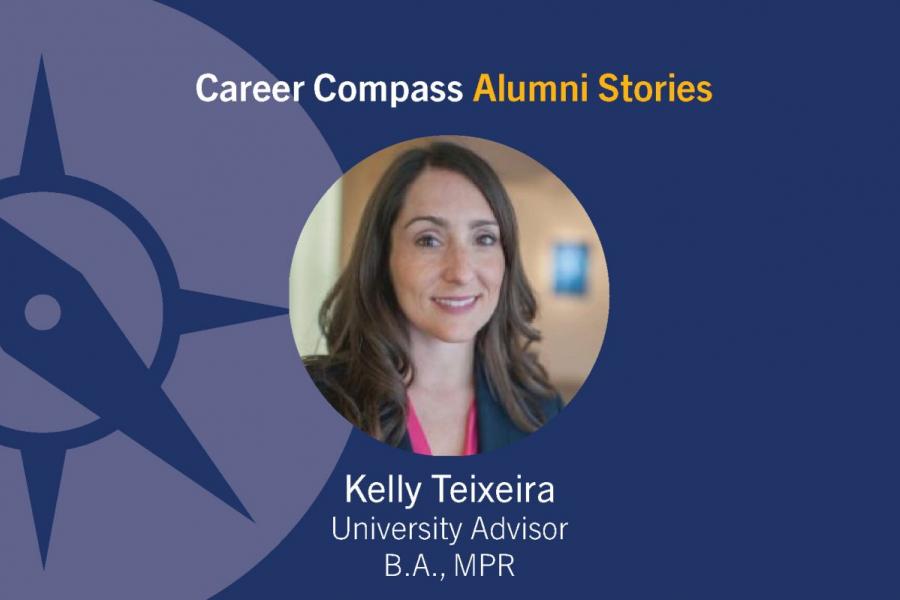
Career Compass Global Political Economy Alumni Story: Kelly Teixeira, University Advisor, B.A., MPR

Kelly Teixeira, B.A., MPR

Kelly Teixeira is a university advisor at St. John’s-Ravenscourt School, an independent university preparatory school in Winnipeg. Kelly advises high school students about university admission requirements, provides assistance with applications for scholarships and post-secondary education, and helps students with first year course selection. Kelly also acts as the primary liaison between St. John’s-Ravenscourt and post-secondary institutions.

Read more about Kelly Teixeira's career path

Briefly, tell us about your job. What do you find most rewarding? What are your greatest challenges within this profession?

I am a university advisor at St. John’s-Ravenscourt School, an independent university preparatory school in Winnipeg. I advise high school students about university admission requirements, provide assistance with applications for scholarships and post-secondary education, and help students with first year course selection. I also act as the primary liaison between St. John’s-Ravenscourt and post-secondary institutions. People often mistakenly believe I am a guidance counsellor. However, I do not offer counselling or career guidance, as we have trained professionals in that area. My role is more of a systems and policy translator.

The most rewarding part of my job is helping students with their decision making. I have the opportunity to support students as they make their own choices. I also love the challenge of learning various policies and procedures, researching the differences between programs and figuring out the unspoken elements to programs and institutions. The most challenging part of my role is working within a high school setting but dealing uniquely with the post-secondary landscape. What matters to one group, is not the same for the other.

What experiences and activities helped you to map out your career pathway?

I’ve had a number of experiences that have really helped me get to where I am today. Each one has shown me that I possess different skills and at the same time, gave me the opportunity to realize what I do and do not want in a career. Too often, people only speak about finding out the things you like to do – I firmly believe that both are equally as important.

I originally wanted to go into athletic therapy. However, after taking first year biology I quickly realized that biology and I we were not friends. I went to a see a University 1 advisor to get information about supports, tutors or anything that could help me improve. The advisor proceeded to ask me an important question: “why?” I completely credit him with helping me to realize that if you don’t enjoy the journey, you most likely aren’t going to enjoy the destination. He was the one that told me about the global political economy program. He made the connection that all the courses I chose as electives, and had done very well in, were actually program requirements.

While completing undergrad program, I was fortunate to be employed on campus. I quickly realized that I needed to work with people. I also knew I wanted to travel and was not ready to settle down. I secured a job with as a student recruitment officer at the University of Manitoba. It was here that I really began to figure out what I liked to do, not just what I enjoyed learning about. This job gave me the opportunity to travel and promote something that I believed in.

As a student, did you see yourself in your current career? What stayed the same and/or changed?

I absolutely did not see myself in my current job. When I think back through all the careers I considered (athletic therapy, law, policy analysis, international relations, communications and marketing) I can see why they were at one time or another, a possibility. The reasons for considering them are still the same; the thing that has changed is I now realize what I don’t like about each discipline. My current job that allows me to combine all the things I liked about each of those career options. I enjoy working with people and being active; I like doing research and comparing similar/different policies, process and procedures; I adore traveling and meeting with different people from different countries, backgrounds, languages; and I enjoy communicating with people, developing marketing strategies and helping people create their public image. That said, ultimately I really value being able to help and provide a service to others.

What advice do you have for students who are interested in pursuing a degree in global political economy?

  1. Be prepared to read and write, a lot.
  2. Stay up date on current global and national affairs.
  3. Choose electives from areas outside of the program departments. Global political economy is all about exploring issues from various perspectives and learning how they impact one another.
  4. Try to gain international experience during your degree. People will automatically assume due to the name of the program that you will have had international experience.
  5. Find a group of peers to connect with. You will be sitting in many classes comprised of people who are not in the global political economy program and are, therefore, limited in their perspectives. Once you get to know people other people in your program, you will start to find them in other classes.

What job search advice do you have for students and recent graduates?

Be open but selective. You need to be open to different experiences because everything you do will help you in the future. It may serve as perspective or it may only help you identify what you do not enjoy doing. Most likely, you will not be applying for positions that request a global political economy degree. Therefore, you need to be prepared to apply your skills within various settings and for different purposes. This interdisciplinary degree is such an amazing opportunity. Life is interdisciplinary, it is not rigidly placed in one department and this degree offers you the chance to expand your critical thinking skills, not only for academic purposes but for your work activities as well.

Tell us a fun fact about your career path.

During my undergraduate degree, I was accepted to go on a university exchange program through St. Paul’s College and the Faculty of Arts. This opportunity took me to San Luis Potosi, Mexico where I took human rights Law, Spanish and political and anthropology courses all taught in Spanish. I did research on how environmental impacts can directly affect our human rights and worked as an intern with the State Commission for Human Rights. This was one of the most eye opening experiences of my life. I had been to Mexico many times before, however, having the opportunity to actually see different professions at work in another culture was incredible; seeing the behind the scenes reality of human rights in another country was shocking.

Campus resources and supports

Get one-on-one help

  • Meet with a career consultant

    Meet with a career consultant for a confidential discussion about your career goals, job search, resumé/CV and interview preparation.

    Contact Career Services at cs.receptionist@umanitoba.ca or call 204-474-9456 to make an appointment.

  • Talk to an academic advisor

    Talk to an academic advisor who will guide you to resources to help you make important decisions for your future. Advisors are specialized, often by program, faculty/school or unit.

    Find your advisor

Continue exploring

Select a Career Compass

Use Career Compass as a guide to develop a strong connection between your studies and your occupational choices. It will provide you with suggestions for academic and career planning specific to your program.

Advisors and Educators Guide

Contact us

Connect with the faculty

Global Political Economy
333 Isbister Building
University of Manitoba (Fort Garry campus)
Winnipeg, MB R3T 2N2 Canada

204-272-1655

Connect with Career Services

Career Services
Room 474 UMSU University Centre
65 Chancellor's Circle
University of Manitoba
Winnipeg, MB R3T 2N2 Canada

204-474-9456
204-474-7516
Monday to Friday, 9:00 a.m. to 4:00 p.m.