The University of Manitoba campuses and research spaces are located on original lands of Anishinaabeg, Ininiwak, Anisininewuk, Dakota Oyate, Dene and Inuit, and on the National Homeland of the Red River Métis. More

Functional Menu

  • Current students
  • Faculty and staff
  • Alumni
  • Email
  • News and stories

Call To Action Menu

  • Visit
  • Apply
  • Donate
Home

Libraries

Main Menu

  • Access materials
  • Help and services
  • Locations and hours
  • Accessibility services

What are you looking for?

  • Admissions

    • Explore undergraduate studies
    • Undergraduate admissions
    • Graduate admissions
    • Extended Education
    • Indigenous student admissions
    • International student admissions
    • Financial Aid and Awards
    • Apply to UM
  • Academics

    • Experiential Learning
    • Faculties, colleges and schools
    • Academic Calendar
    • Registrar's Office
    • Libraries
    • Undergraduate programs
    • Graduate programs
    • Extended Education programs
  • Research

    • Opportunities and support
    • Research Chairs
    • Centres and institutes
    • Partnerships and Innovation
    • Awards and recognition
    • International Centre
    • ResearchLIFE
  • Student supports

    • Academic supports
    • Career Services
    • Get involved
    • Student health and wellness
    • Military Support Office
    • Respectful conduct
    • Student services at Bannatyne campus
    • Accessibility for students
  • Community

    • Indigenous community
    • Alumni
    • Arts and Culture
    • Sport and Recreation
    • Giving
  • About UM

    • Governance
    • Strategic Plan
    • Our campuses
    • The UM brand
    • Facts and figures

Libraries

Main Menu

  • Access materials
  • Help and services
  • Locations and hours
  • Accessibility services

The University of Manitoba campuses and research spaces are located on original lands of Anishinaabeg, Ininiwak, Anisininewuk, Dakota Oyate, Dene and Inuit, and on the National Homeland of the Red River Métis. More

University of Manitoba

Functional Menu

  • Current students
  • Faculty and staff
  • Alumni
  • Email
  • News and stories

Call To Action Menu

  • Visit
  • Apply
  • Donate

University of Manitoba
Winnipeg, Manitoba Canada, R3T 2N2

Maps and directions
1-800-432-1960 (North America)
Emergency: 204-474-9341
Emergency Information
  • Careers
  • Media
  • People search
  • Research experts
  • Privacy policy
  • Accessibility
  • Terms of use
  • Website feedback
  • All social

Libraries

Breadcrumb

  1. Home
  2. Libraries
  3. Administration
  4. Indigenous art in the Libraries

Administration

  • Annual reports
  • Strategic directions
  • Indigenous art in the Libraries
  • Guidelines and rules

Indigenous art in the Libraries

Featured art

This art project is part of the UM Libraries strategy and Reconciliation Action Plan goal to make spaces more welcoming to Indigenous students and to help students, faculty and staff feel proud of their library spaces. The art not only directly supports Indigenous artists, but is also intended to help students feel like they belong in spaces they might not have previously imagined themselves in.

  • Read more about the project on UM Today

Click each photo to visit the artist's website.


  • "For Jean-Guy" by Daphne Boyer

    Location: Elizabeth Dafoe Library, first floor

    “Our dear friends Leslie and Giles Hogya recently lost their son Jean-Guy. Here is how Leslie described the day of Jean-Guy's burial.

    "The day threatened, there was wind, a storm of snow. Would the burial be postponed? We were stunned to see his coffin draped with the Métis flag. His birth mother, Arlette Adia, whom I met for the very first time at the gravesite, had arranged to honour his Indigenous heritage this way.
    My son Jean-Guy Okwala Hogya touched everyone with his dynamic presence. As a friend said, 'He was like a meteor streaking across the sky.'"

    Leslie is a member of Moms Stop the Harm, a network of Canadian families impacted by substance-use related harms and deaths. The group advocates to change failed drug policies that contribute to the opioid public health emergency and provides peer support to grieving families and those with loved ones who use or have used substances.”

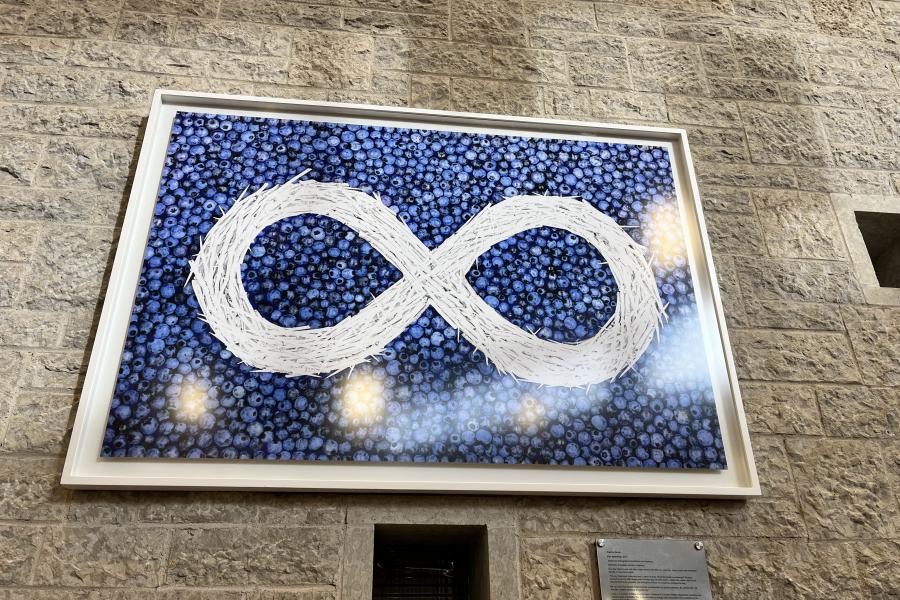
    Daphne Boyer is a visual artist and plant scientist of Red River Métis descent, born in Saskatchewan. She is known for combining natural materials like plant material, berries, or porcupine quills with women’s traditional handiwork using high-resolution digital tools. Her art celebrates her Indigenous heritage and honour plants and animals as kin. For Jean-Guy is inspired by an image from the burial of the son of Boyer’s friends Leslie and Giles Hogya, where his coffin was draped with the Métis flag.

    For Jean-Guy uses one of Boyer’s techniques of photographing individual berries and manipulating them digitally in the style of traditional beading.

  • An framed art piece that looks like a Metis flag
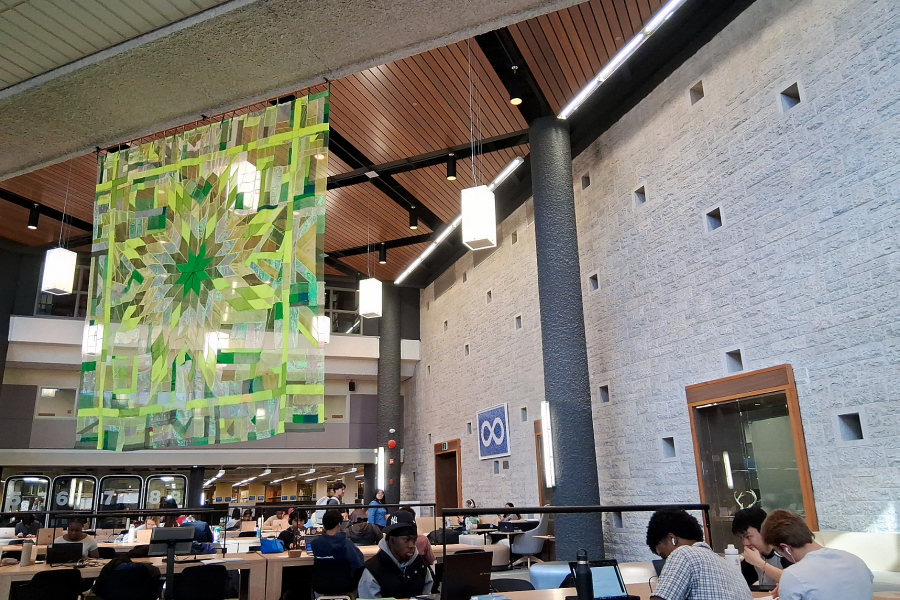
  • "Grass Star Quilt" by Wally Dion

    Location: Elizabeth Dafoe Library, first floor

    Wally Dion is a Canadian artist of Saulteaux ancestry currently living and working upstate New York but originally born in Saskatoon. The shimmery, transparent fabric green star quilt is the first quilt in a series that re-envisions the prairie ecosystem and the reintroduction of the bison to the Great Plains. Dion “started with the green quilt because it is the colour of the sweet grass braid that is exchanged in ceremony and relationship-building.”

  • Transparent quilt hanging over study space in Dafoe
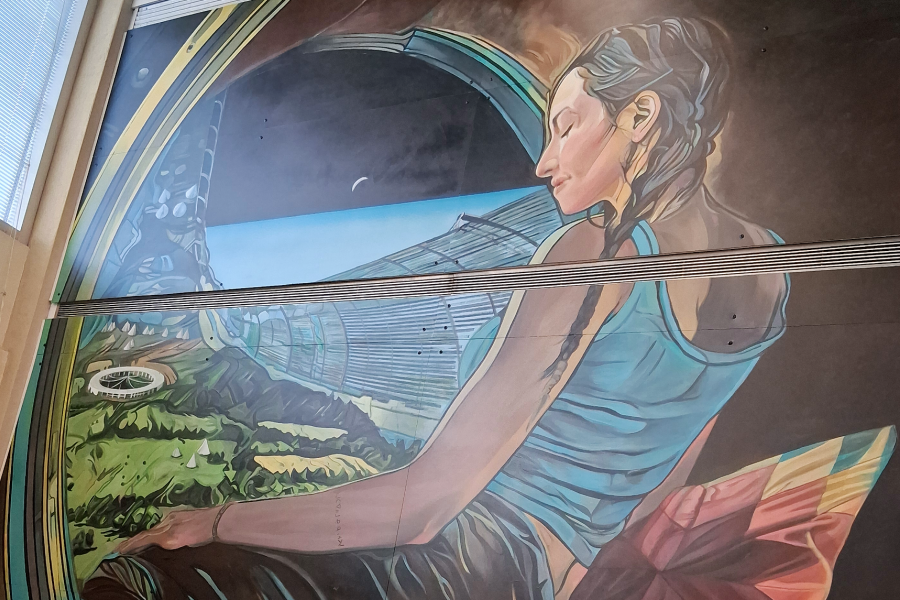
  • "Echoes of the Earth" by Mike Valcourt

    Location: Elizabeth Dafoe Library, second floor

    Mike Valcourt has been painting professionally since 1995, with years of experience painting murals and mentoring youth through Take Pride Winnipeg and Graffiti Gallery. "I am easily influenced by the Woodlands style of art,” Valcourt says, “maintaining its narrative, sometimes derivative, yet contemporary quality,” and he finds “the art of Jackson Beardy to be a great source of inspiration and vision.” Valcourt has also worked on other University of Manitoba murals, such as the Truth and Reconciliation in Engineering mural in the Price Faculty of Engineering.

    In its current location, Echoes of the Earth inspires a vision of the future in contrast to a previously installed Indigenous mural exhibiting a view of the past.

    Read the full artist statement.

  • A large mural of an Indigenous woman looking down from space
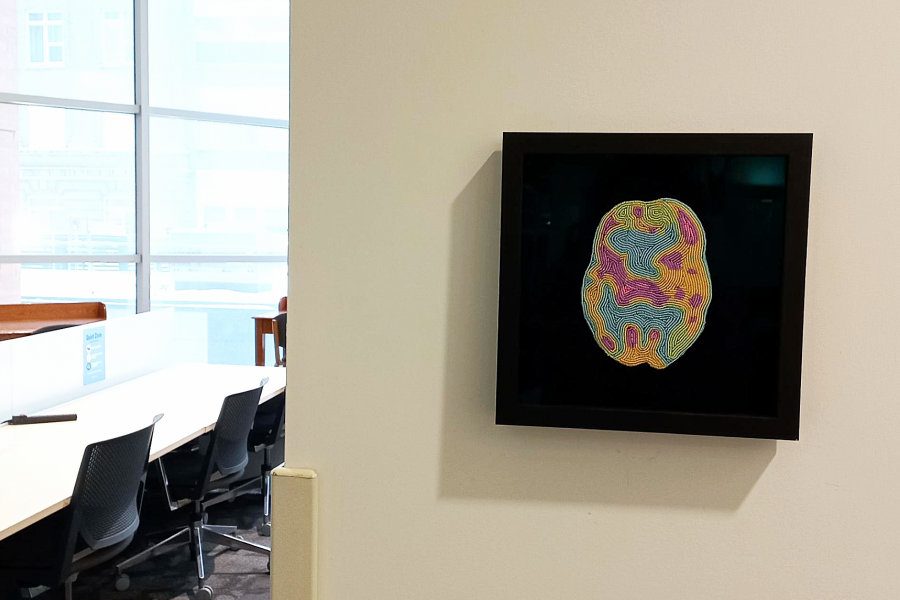
  • "Anxiety" by Ruth Cuthand

    Location: Neil John Maclean Health Sciences Library

    Ruth Cuthand was born on Treaty 6 Land of Plains Cree and Scottish ancestry. Anxiety is one of a series of beaded brain scans based on medical resonance imaging of the brains of neurodiverse individuals and people with various mental health issues. The project is a collaboration with her adult son, Theo, and tells the story of his mental health crisis.

  • A beaded brain scan framed on a wall
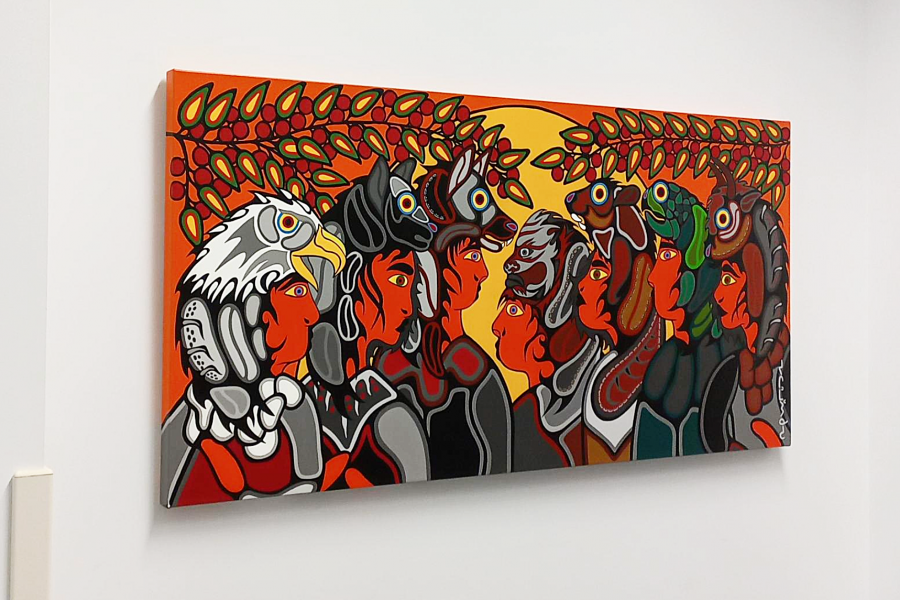
  • "Seven Teachings" by Eugene Morriseau

    Location: Neil John Maclean Health Sciences Library

    Eugene Morriseau is a Canadian artist born in 1964 and son of Norval Morriseau, a member also known as Copper Thunderbird, was an Indigenous Canadian artist from the Bingwi Neyaashi Anishinaabek First Nation and a member of the “Indigenous group of seven.” Morriseau is widely regarded as the grandfather of contemporary Indigenous art in Canada, and is the founder of Canadian-originated school of art called Woodland or sometimes Legend or Medicine painting. Eugene Morriseau continues in his father’s style.

  • An Indigenous Woodlands-style art piece
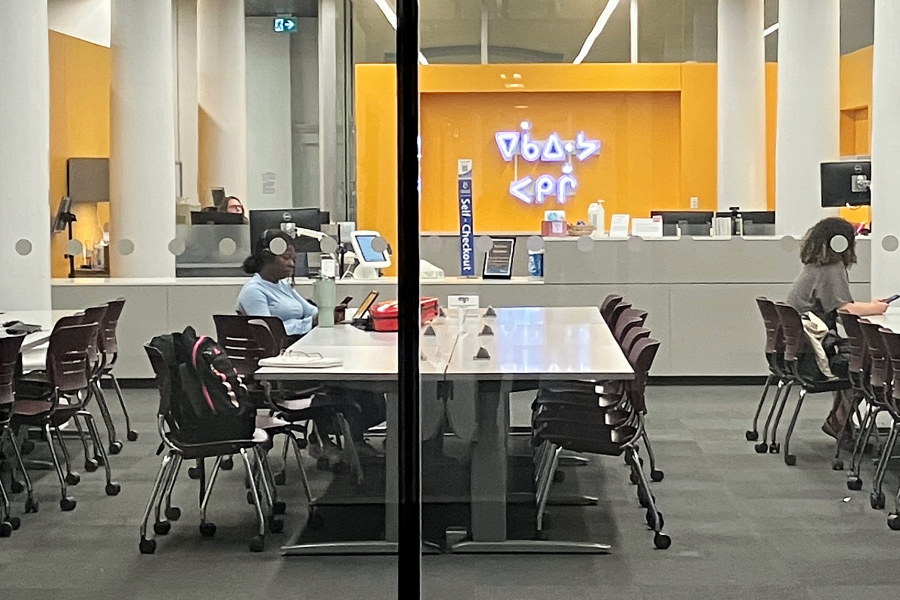
  • "ᐁᑳᐏᔭ ᐸᑭᒌ (ēkāwiya pakicī / Don’t Give Up" by Joi T. Arcand

    Location: Sophie-Carmen Eckhardt-Grammatté Music Library

    For Joi T. Arcand, an artist from Uskeg Lake Cree Nation, Saskatchewan, Treaty 6 Territory, the written Cree language “is not only imbued with cultural significance – it’s an aesthetically beautiful form unto itself.” (CBC). She believes the Cree language deserves to be more visible to the general public, and her most recent work reproducing nēhiyawēwin into neon lights is an extension of her work reclaiming and Indigenizing public spaces through the use of Cree language and syllabics.

  • Cree in neon on the back wall of a library
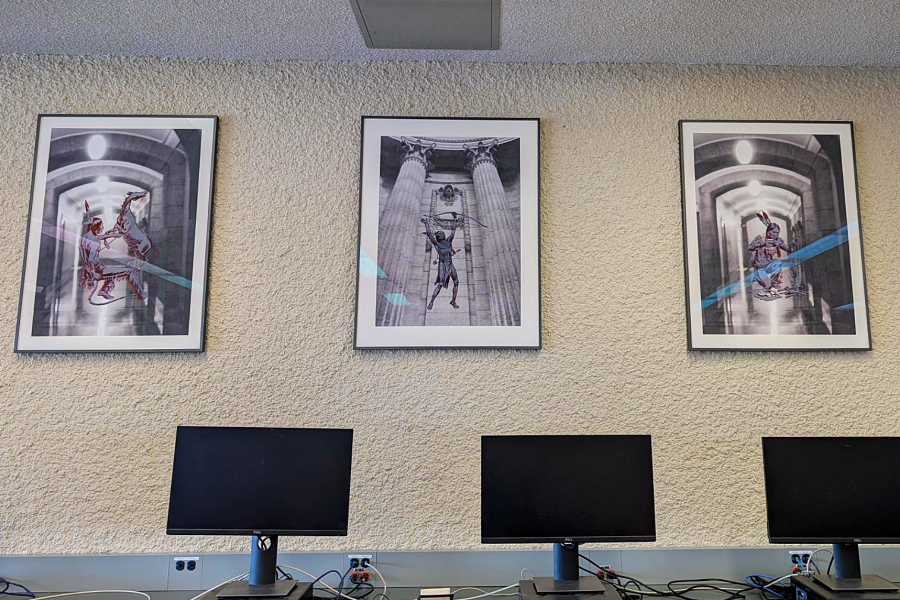
  • "Ancestors at the Manitoba Legislature" series by Kevin McKenzie

    Location: E.K. Williams Law Library

    Ancestors at the Manitoba legislature series, 2018 by Kevin McKenzie includes three large screenprints on photography that feature graphic art of Indigenous men in traditional clothing and weapons printed over blurry, grayscale photographs of the architecture of the Manitoba legislature.

    Kevin McKenzie is a Cree/Metis, Saskatchewan artist, based in Brandon, Manitoba. He is a member of the Cowessess First Nation of Saskatchewan, Treaty 4. McKenzie’s art “juxtaposes sacred and ceremonial objects from Indigenous cultures with similar objects from settler cultures, building tension between elevation and denigration."

  • 3 framed art pieces on a wall, photos of the legislature with graphics of Indigenous men hunting overlayed
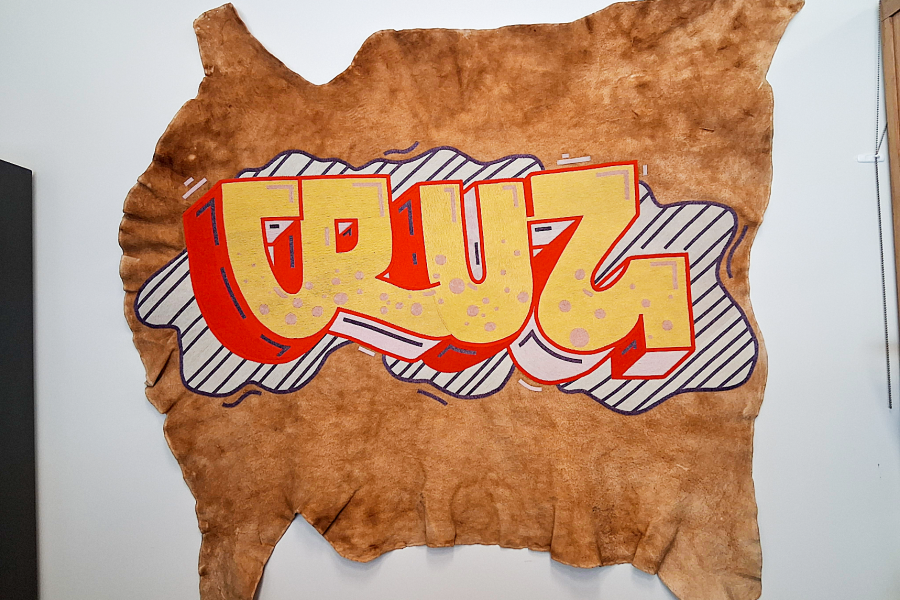
  • "Exploit Robe (Going Pro)" by Judy Anderson

    Location: Architecture/Fine Arts Library

    "Exploit Robe (Going Pro)" is the second piece in a series where the artists honours her son, Cruz, in his journey as a graffiti artist/writer and as he transitioned into manhood by beading his burners on moose hide. The first piece in this collaboration, "Exploit Robe (Toying Around)", acknowledges his inexperience as a writer while honouring the beginning of his journey as an artist. The second piece in this series, "Exploit Robe (Going Pro)", highlights the natural progression of Cruz’s writing practice and the artist's growing proficiency as a beader. At the same time, it acknowledges the history of Plains Indigenous men’s exploit robes. While Cruz no longer writes, he is now an atelier painter, and this series will naturally shift to honour his exploits in painting.

    Judy Anderson is Nêhiyaw (Cree) from Gordon First Nation, Saskatchewan, Treaty 4 territory and a Professor of Canadian Indigenous Studio Art in the Department of Art at the University of Calgary.

  • A beaded hide with the text "Cruz" in graffiti on it
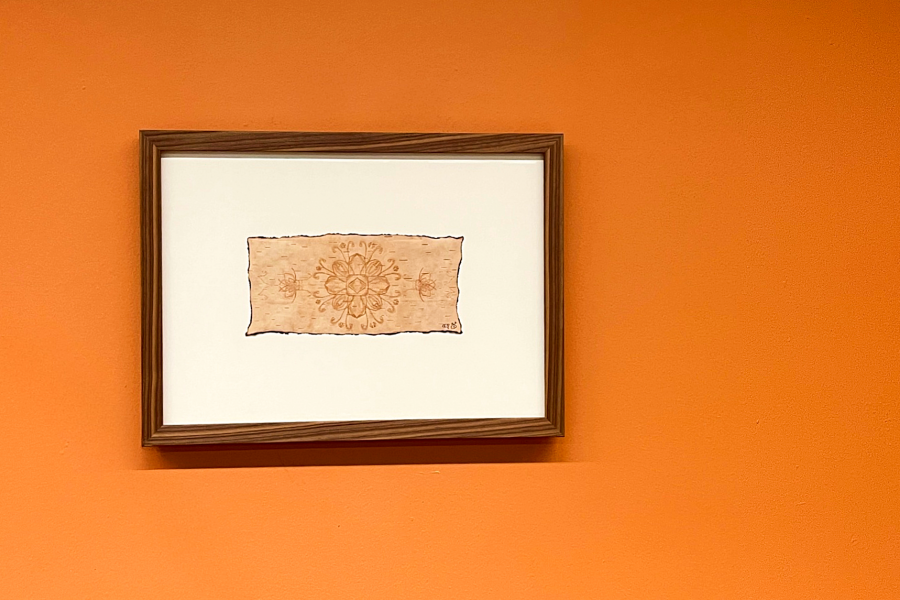
  • "Bee Love" by Pat Bruderer

    Location: Father Harold Drake Library, St. Paul's College

    Pat Bruderer is originally from Churchill, Manitoba, spent most of her life in northern Manitoba and now resides in the Kootenay area of British Columbia. She is a member of Peter Ballantyne Cree Nation in Saskatchewan and is a self-taught birch bark biting artist who has been practicing for over twenty years.

    Birch bark biting was an ancient traditional art form done with teeth, creating images by biting into very thin layers of birch bark, but it was almost lost because of colonization and residential schools as it was usually passed down through families. It was once done all across Turtle Island, and was used for recording stories, ceremonies, and creating patterns. “It was originally called birch bark transparencies, because when held to the light you can see through it and it turns to gold,” Bruderer says. “Birch bark biting are like people, they’re beautiful and there’s no two the same.”

    Bee Love was created as a way to “honour the bees”, Bruderer says, “because if it wasn’t for the bees, we wouldn’t exist on this planet.”

  • Piece of birch bark biting in shape of a flower
  • "Northwest 2, 3, 4" by Tracy Charette Fehr

    Location: Father Harold Drake Library, St. Paul's College

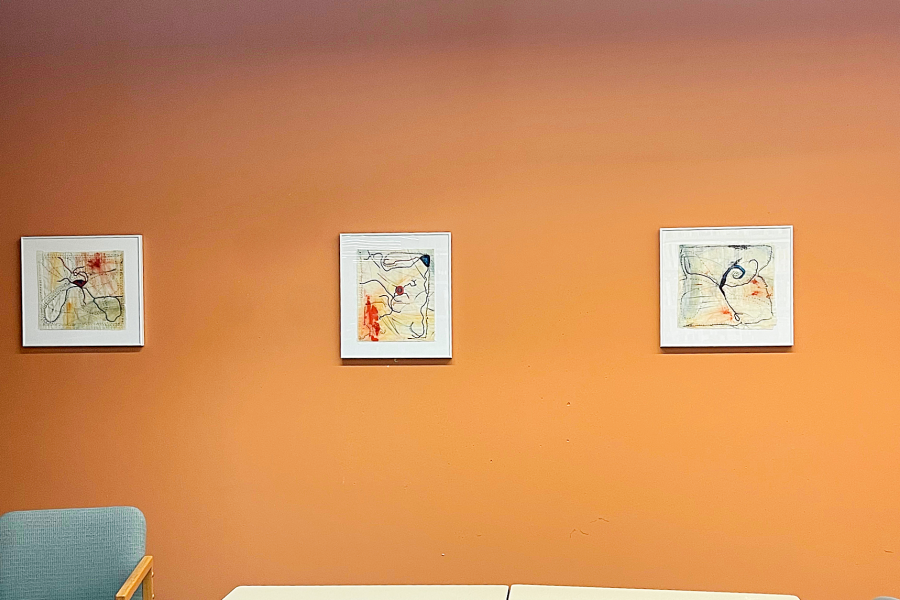
    Tracy Charette Fehr is an interdisciplinary artist and a Red River Métis citizen with a special interest in Indigenous arts and culture, including handwork in beading, quillwork, embroidery, and clay. Northwest 2, 3, and 4, displayed in Father Harold Drake Library in St. Paul’s College, represent the Northwest landscape using Métis art traditions of beading and embroidery to depict rivers, bloodlines and land. Charette Fehr hopes students “will enjoy the blend of textures, lines and images” and “will get a sense of the landscape of feeling, imagination, identity and spirit that I try to convey.”

  • 3 framed embroidered art pieces that look like veins and riverways
  • "Honouring the Land" and "Looking Myself in the Eye" by Marcy Friesen

    Location: St. John's College Library

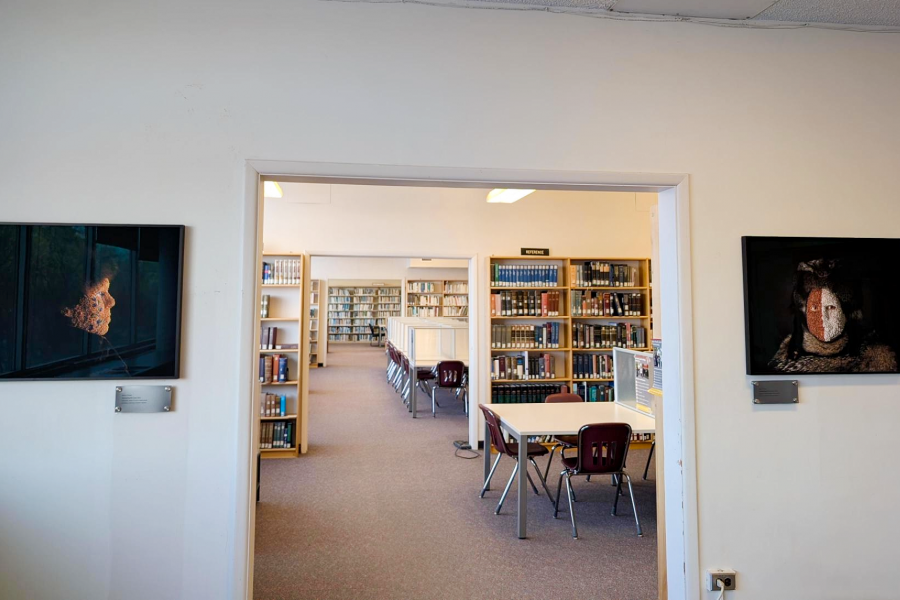
    Marcy Friesen, of Swampy Cree and Welsh ancestry and currently resides near Carrot River, SK, likes pushing the boundaries of how beads were traditionally used, which is reflected in Looking Myself in the Eye and Honouring the Land, where she beaded her own lips and face. Since visiting the Modern Art Gallery in Saskatoon, Friesen has changed her focus to creating “useless” pieces of art. Friesen says, “I thought, ‘I’m going to make a pair of moccasins, and how can I make them useless?’ So I beaded the inside of them so you can’t wear them. And then I thought, ‘How can I make them more useless?’ so I only made one.”

  • Two framed art pieces of headshots of women with beaded faces on either side of a door leading into a library
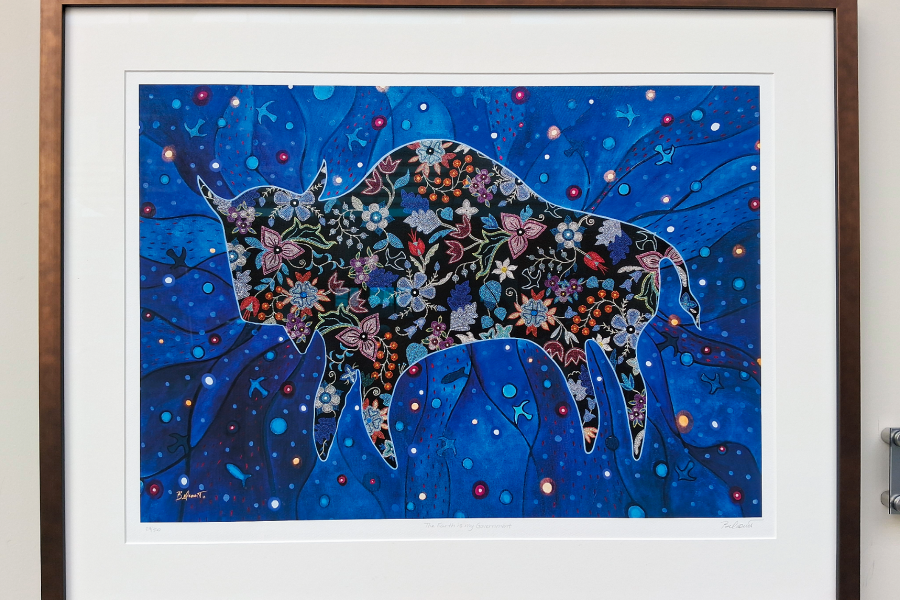
  • "The Earth is my Government" by Christi Belcourt

    Location: Engineering study commons

    “The earth is my gov’t. By its laws, we learn we are to live harmoniously with each other and all things on Earth.”

    Christi Belcourt (apihtâwikosisâniskwêw / mânitow sâkahikanihk) is a visual artist, environmentalist, social justice advocate, and avid land-based based arts and language learner. She is most well known for her large painted floral landscapes of Métis beadwork. Belcourt’s goal with her art is to motivate people to protect the land and waters in the areas where they live.

  • Indigenous art of a Bison with Metis-style beadwork patterns against blue background

Administration

  • Annual reports
  • Strategic directions
  • Indigenous art in the Libraries
  • Guidelines and rules
Home
  • Careers
  • Media
  • People search
  • Research experts
  • Accessibility

University of Manitoba
Winnipeg, Manitoba, Canada

Maps and directions
1-800-432-1960 (North America)
Emergency: 204-474-9341
Emergency information
  • All social
  • Privacy policy
  • Terms of use
  • Website feedback

© 2026 University of Manitoba